Steel Rail & Railway Rail Solutions
Glory Rail provides professional steel rail & railway rail solutions, covering railway, crane, and industrial track systems, with custom processing and global project support.
- Custom Processing
- International Standards
- Global Projects
What is a Steel Rail System?
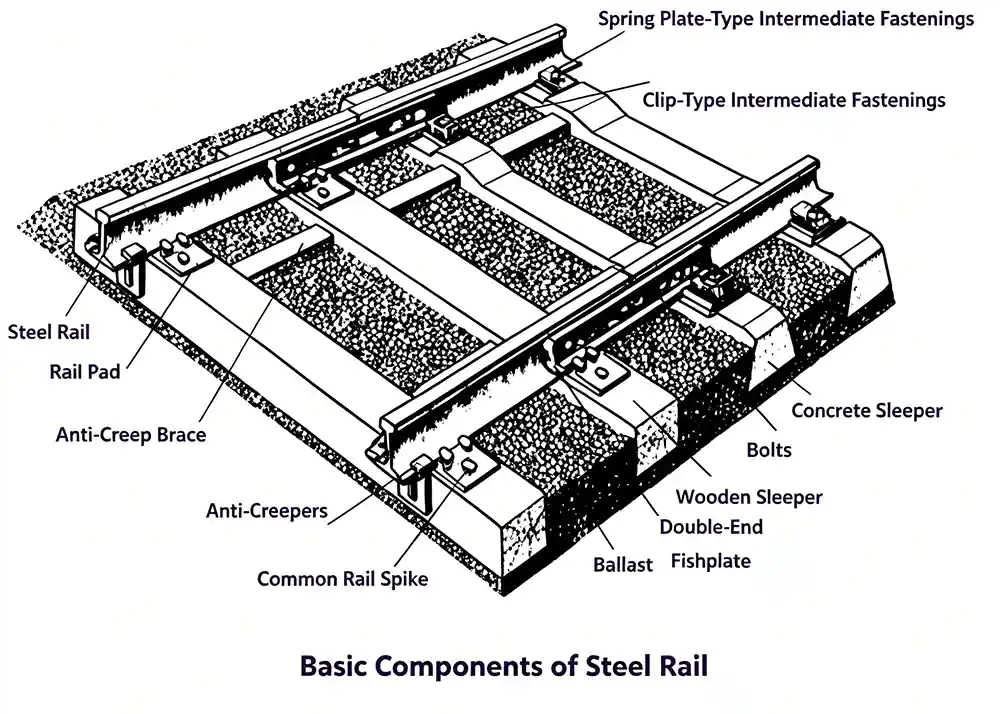
A steel rail system is a complete track solution for railway, crane, and industrial applications, including steel rails, fasteners, sleepers, ballast, and joint devices. Proper design considers rail profiles, welding, expansion joints, installation tolerances, and load requirements. Glory Rail provides expert guidance on rail selection, system design, and industrial track solutions worldwide.
Steel Rail System Components
- Steel Rail: Carries wheel loads and guides movement to the structure below.
- Rail Clips: Hold rail in position on baseplate, limit side and uplift movement.
- Rail Pad: Sits between rail and baseplate, reduces impact and vibration.
- Rail Spike: Used where bolting is not applied, fixes rail or base directly into sleeper/concrete.
- Sleepers: Keep rail spacing, spread loads into ballast or foundation.
- Ballast: Stone layer under sleepers, drains water and keeps track in position.
- Fastenings: Everything that ties rail, pad and sleeper together as one system.
- Anti-creep Devices: Stop rail shifting along track under repeated train force.
- Grout: Fills gaps under baseplate, helps rail sit fully on concrete base.
How to Choose the Right Steel Rail?
Key Considerations When Selecting Steel Rails
| Selection Factor | Engineering Condition | Requirement / Consideration | Recommended Rail Solution |
| Environmental Conditions | Cold regions / high altitude | Maintain low-temperature toughness to prevent brittle fracture under thermal stress and dynamic load | Low-temperature resistant rail steel |
| Coastal / industrial areas | Resistance to corrosion, humidity, and chemical exposure | Weathering steel / corrosion-resistant coated rails | |
| Load & Railway Specification | Light to medium traffic | Standard axle loads and moderate operating intensity | Standard rail profiles |
| Heavy haul / freight railway | High axle load, continuous dynamic impact, fatigue resistance required | UIC60 / 75kg heavy rail | |
| Material Properties | General railway lines | Balanced strength and wear resistance | U71Mn carbon steel rail |
| Heavy traffic / main lines | Enhanced hardness and wear resistance via heat treatment | U75VG heat-treated rail | |
| Coastal / acidic environments | Corrosion resistance required to reduce surface degradation | Copper-bearing / weathering steel rail | |
| Track Gauge Compatibility | Standard gauge (1435 mm) | Global mainstream system, ~60% railway networks | Standard rail system (UIC / EN compatible) |
| Broad gauge (1520–1676 mm) | Higher axle load capacity and regional compatibility required | Heavy-duty rail system adapted to broad gauge | |
| Narrow gauge (610–1067 mm) | Lower construction cost, limited load capacity | Light rail profiles for narrow gauge systems |
Understanding Rail Type Differences
After understanding selection factors, it is also important to distinguish between different rail types used in railway and industrial systems. Steel rails and crane rails are designed for different operating conditions and load behaviors.
Steel Rail vs Crane Rail — Key Differences
| Category | Steel Rail | Crane Rail |
|---|---|---|
| Application | Railway transportation systems for passenger and freight movement | Industrial crane systems, ports, yards, and overhead lifting operations |
| Load Characteristics | Distributed wheel loads with continuous longitudinal movement | Concentrated wheel loads with high vertical and lateral impact forces |
| Section Profile | Standard rail profiles such as UIC54, UIC60, QU series for railway use | Reinforced crane rail profiles such as A45, A65, A100, QU70, QU100 |
| Mechanical Function | Designed for stability, alignment, and long-distance running performance | Designed for impact resistance, shock absorption, and repeated start-stop operation |
| Contact Behavior | Rail-wheel contact under relatively stable rolling conditions | High-pressure point contact under heavy crane wheel loads |
| Installation System | Ballasted or slab track with sleepers and fastening systems | Fixed installation with baseplates, clamps, or welded steel structures |
| Standards | UIC, AREMA, EN, JIS, BS, GB, Russian standards | DIN 536, UIC, EN, JIS, BS, GB crane rail standards |
| Typical Use Cases | Mainline railways, freight corridors, passenger rail networks | Gantry cranes, STS cranes, ASC systems, industrial yards |
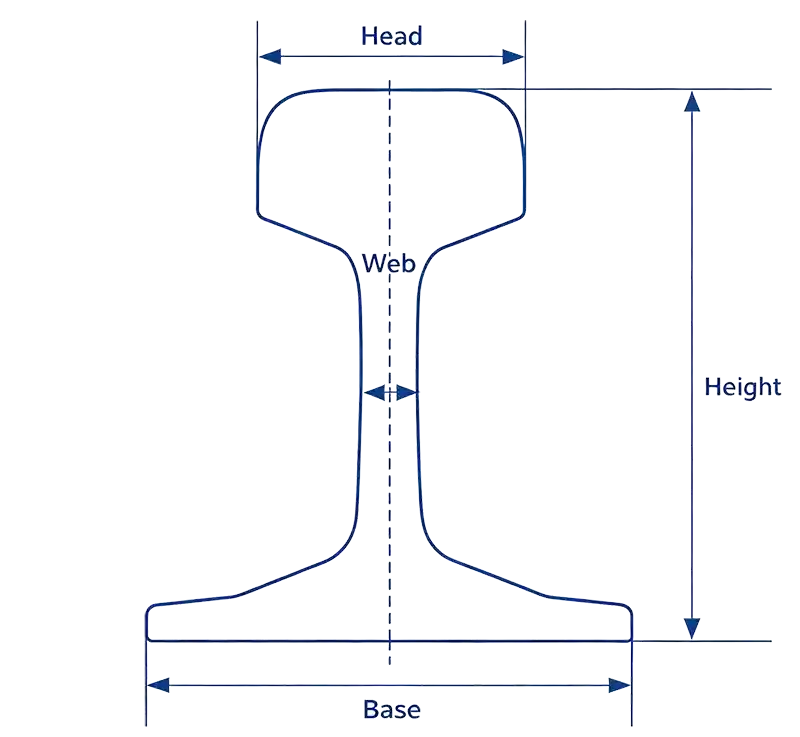
Steel Rail Profiles — Commonly Used Types
| Rail Type | Standard | Size | Material | Standard Length |
|---|---|---|---|---|
| QU Series | Chinese YB/T 5055-2014 | QU70, QU80, QU100, QU120 | U71Mn, U75V | 12m |
| A Series | German DIN536 | A45, A55, A65, A75, A100, A120, A150 | 50Mn, U71Mn | 10/12/15m |
| ASCE Series | American ASTM, AREMA | ASCE25, ASCE30, ASCE40, ASCE60, ASCE70, ASCE85, 115RE, 136RE | 700/900A/1100 | 6-12m, 12-25m |
| UIC Series | International Union of Railways UIC860-0, EN-13674-1 | UIC50, UIC54, UIC60 | 900A/1100 | 12-25m |
| Mining Rail | GB/T 11264-2012 | 8kg, 9kg, 12kg, 15kg, 18kg, 22kg, 24kg, 30kg | Q235B, 55Q | 6-24m |
| Heavy Railroad Rails | GB 2585-2007 | 38kg, 43kg, 50kg, 60kg, 75kg | 50Mn, U71Mn | 6-24m |
| BS Series | British BS11-1985 | BS50’O’, BS60A, BS60R, BS75A, BS75R, BS80A, BS100A, BS113A | 700/900A | 8-25m |
| JIS Series | Japanese JIS E1103/1101 | 15kg, 22kg, 30A, 37A, 50N, CR73, CR100 | According to JIS | 9-10m |
| AS Series | Australian AS 1085 | 31kg, 41kg, 47kg, 50kg, 53kg, 60kg, 66kg, 68kg, 73kg, 86kg, 89kg | 900A/1100 | 8-25m |
| EN Series | EN Standard EN 13674-4 | 54E1, 60E1, 39E1, 45E1, 49E1, 49E2, 49E5, 50E1, 50E6, 54E4 | R200, R260, R260MN, R350HT | 6-24m |
| ISCOR Series | South African ISCOR | 15kg, 22kg, 30kg, 40kg, 48kg, 57kg | 700/900A | 9-25m |
Need Help Selecting the Right Steel Rail?
Our engineering team can recommend the most suitable rail profile and material based on your application, load requirements, and local standards.
Material Grades & Performance
Choosing the Right Rail Steel Grade for Your Application
| Grade | Typical Rail Type | Tensile Strength (MPa) | Hardness (HB) | Key Characteristic |
|---|---|---|---|---|
| U71Mn | QU Series, A Series, Heavy Railroad Rails | ≥ 880 | 260 – 300 | High strength with balanced toughness, industry standard for heavy-haul & high-speed rails |
| U75V | QU Series | ≥ 980 | 280 – 320 | Ultra-high strength micro-alloyed steel, superior impact & fatigue resistance |
| 50Mn | A Series, Heavy Railroad Rails | ≥ 650 | 220 – 260 | Medium carbon steel, good machinability, cost-effective for light-haul tracks |
| Q235B | Mining Rail | 375 – 500 | 137 – 187 | Low carbon steel, excellent weldability, for light-duty mining & temporary tracks |
| 55Q | Mining Rail | ≥ 520 | 180 – 220 | Medium carbon steel, good wear resistance, standard for small-section mining rails |
| 700 Grade Steel | ASCE Series, BS Series, ISCOR Series | ≥ 700 | 200 – 240 | Good strength-to-weight ratio, entry-level grade for light rail & regional lines |
| 900A Grade Steel | ASCE Series, UIC Series, AS Series, ISCOR Series | ≥ 900 | 240 – 280 | High strength carbon steel, superior fatigue resistance, mainstream for international mainlines |
| 1100 Grade Steel | ASCE Series, AS Series | ≥ 1100 | 280 – 320 | Ultra-high strength, excellent wear & impact resistance, for high-speed & heavy-load tracks |
| R200 | EN Series | ≥ 800 | 220 – 260 | EN standard rail steel, good toughness, for regional railways & urban transit |
| R260 | EN Series | ≥ 880 | 260 – 300 | Most widely used EN standard grade, high strength, standard for EU mainline & high-speed rails |
| R260MN | EN Series | ≥ 880 | 260 – 300 | Manganese-alloyed EN steel, superior wear resistance, for heavy-haul & curved tracks |
| R350HT | EN Series | ≥ 1175 | 350 – 390 | Heat-treated high-strength EN steel, ultra-high hardness, for high-speed & heavy-load systems |
Comprehensive Rail Solutions for Every Application
Steel rails are engineered to meet the demands of different transport and industrial settings. At Glory Rail, we supply a wide selection of rail types—from standard railway sections to heavy-duty crane rails—each tailored for specific load, durability, and installation needs.
Applications:
Underground mines & material transport.
Temporary tracks & auxiliary lines.
Small-scale industrial tunnel paths.
Technical Specs:
Material: 55Q / Q235B Steel.
Standard: GB/T 11264.
Models: 8kg, 9kg, 12kg to 30kg.
Applications:
High-capacity mine haulage lines.
Port machinery & steel plant routes.
National mainline railway sections.
Technical Specs:
Material: U71Mn High-Carbon Steel.
Standard: GB2585.
Models: 38kg, 43kg, 50kg to 75kg.
Applications:
Heavy-duty overhead crane systems.
Gantry cranes in ports & shipyards.
Automated warehouse conveyor lines.
Technical Specs:
Material: U71Mn / 50Mn Alloy Steel.
Standard: DIN 536 (German Standard).
Models: A45, A55, A65, A75, A100, A120.
Applications:
Industrial crane trolleys & tracks.
Steel plant heavy lifting equipment.
Large-scale workshop crane runways.
Technical Specs:
Material: U71Mn / High-Carbon Steel.
Standard: YB/T 5055 (Chinese Standard).
Models: QU70, QU80, QU100, QU120.
Applications:
High-speed & mainline passenger railways.
Heavy-haul freight transport networks.
Urban rail transit & metro systems.
Technical Specs:
Material: R260 / R350HT Steel Grade.
Standard: UIC 860 / EN 13674-1.
Models: UIC 54, UIC 60.
Applications:
Overhead cranes & bridge crane tracks.
Warehouse & commercial building structures.
Industrial equipment frame reinforcement.
Technical Specs:
Standard Sizes: 30×40mm, 100×100mm.
Customization: Tailored dimensions.
Facility: Direct supply from Glory Rail factory.
Successful Cases Of Our Steel Rail

S49 Rail for Stacker Machine – Export Project to Thailand
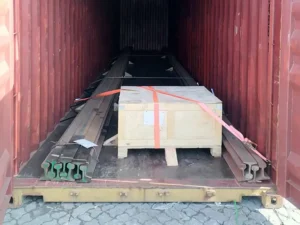
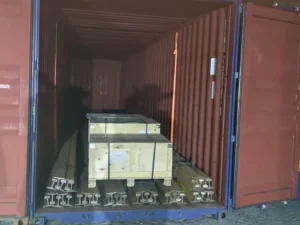
Glory Rail’s S49 rail for stacker machine: custom 5mm chamfer, flash rust resolved, shipped Tianjin to Bangkok. Customer approved.

ASCE60 Crane Rail Vertical Bending Solution for Indonesian Conveyor Project
Glory Rail recently completed an ASCE60 Crane Rail Vertical Bending solution for a conveyor project in Indonesia requiring smooth elevation transition within a confined installation space.

Sri Lanka A65 Rail for Port Machinery Coating Requirement Delivered
Case study: A65 rail for port machinery with heavy-duty coating (260μm, RAL1007) for Sri Lanka Port Authority. Non-coating area clarified. By Glory Rail.

Shipboard Deck Crane Rail System | Pakistan A45 Crane Rail Replacement
Shipboard deck crane rail system replacement in Pakistan: A45 rail, welded clips, SA2.5+3-layer coating. From Tianjin to Karachi.

Mobile Harbor Crane Rail System | Jakarta A100 Rail Supply
Glory Rail delivered a complete Mobile Harbor Crane Rail System – including DIN 536 A100 rail, WJ220 clips, chemical anchors, and leveling bolts – for a 300t crane at Jakarta Port.

Fertilizer Conveyor Rail System | Pakistan A75 Rail Replacement
Glory Rail provided a complete A75‑based Fertilizer Conveyor Rail System for a Pakistan contractor.