Overhead Crane Rails
Introduction
overhead crane rails are load-bearing and guiding foundation structures specially laid for the operation of bridge cranes. It is like the “ground highway” of cranes, directly determining the operational safety, smoothness, work efficiency and service life of lifting equipment.
As a key component connecting heavy equipment and building structures, our crane track system is committed to providing customers with safe, reliable, precise, stable and durable solutions.
Design Features of Overhead Crane Rails
The crane tracks need to bear relatively high lateral loads to ensure the stability and safety of the crane. Glory Rail is committed to providing high-quality crane track solutions to meet the demands of various industrial applications.
| Feature | Description & Benefit |
|---|---|
| Wide Base Design | Ensures stability under high lateral loads, preventing rail deformation or damage. |
| Thickened Web | Enhances the load-bearing capacity of the rail, making it particularly suitable for heavy-duty crane applications. |
| Special Profiles | We offer a variety of heavy-duty crane rail profiles, including GB, DIN, BS, EN, JIS, and AS standards, to meet the requirements of different regions and industries. |
| Customization Service | We provide tailor-made solutions based on specific client needs, ensuring optimal performance for every project. |
Overhead Crane Runway Rails: Three Common Types
There are three primary types of runway rails for overhead cranes: crane rails, P-type railroad rails, and square steel.
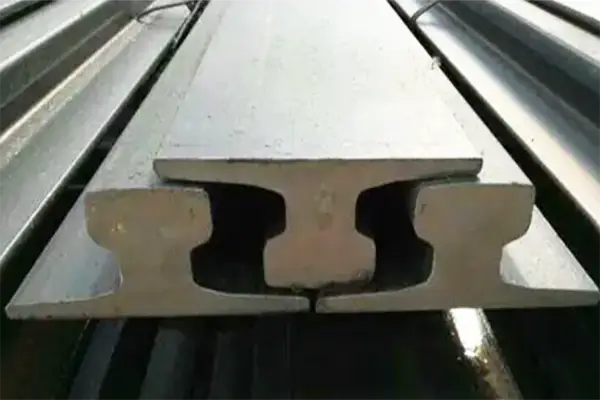
Crane Rail: This type features a curved head and a flat base with a certain width, which increases the contact area with the supporting foundation. It is the most widely used type today.
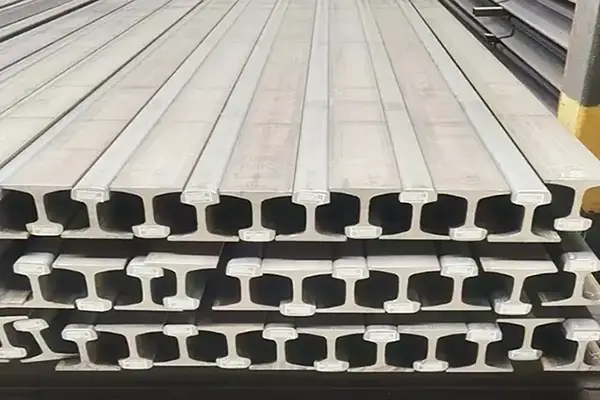
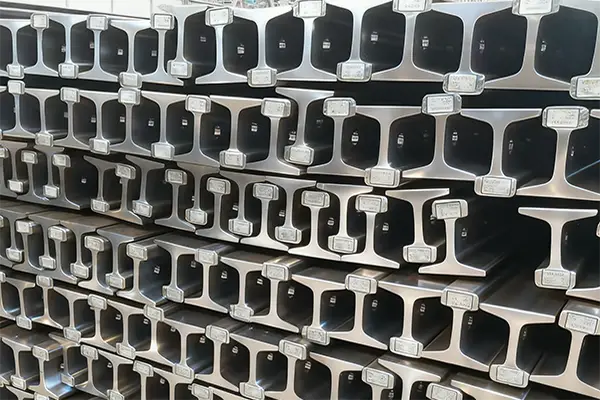
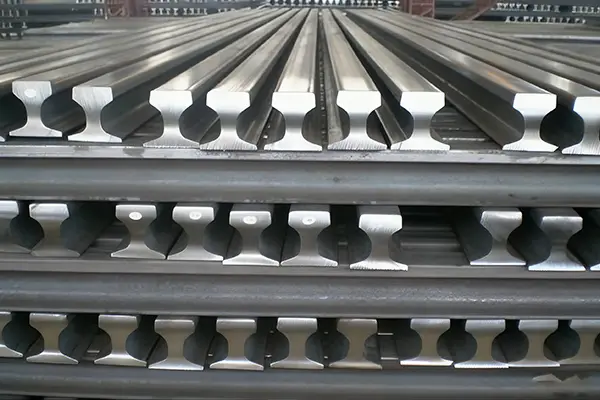
P-type Railroad Rail: Its cross-section is I-shaped, providing excellent bending strength.
Square Steel: This can be considered a flat-top rail. It is now rarely used due to its tendency to cause significant wear on crane wheels.
Crane rails are typically rolled from steel with high carbon and manganese content.
Crane Rail Chemical Composition
| U71Mn | Chemical Composition(%) | |||||||
| C | Si | Mn | S | P | Cr | Ni | Cu | |
| ≤ | ≤ | ≤ | ≤ | ≤ | ||||
| 0.65-0.76 | 0.15-0.35 | 1.10-1.40 | 0.03 | 0.03 | 0.25 | 0.25 | 0.25 | |
Types of Overhead Crane Rails
Crane Rail Selection Guide: Key Parameters & Considerations
The selection of the appropriate crane rail is a critical engineering decision. The following table outlines the core parameters that guide the selection process to ensure optimal safety, performance, and longevity.
| Parameter | What It Means | Why It Matters | Selection Influence |
|---|---|---|---|
| 1. Maximum Wheel Load | The greatest vertical force exerted by a single crane wheel on the rail. | Determines the static strength requirement. An undersized rail will suffer from excessive bending stress and surface crushing. | Primary driver for rail size. A higher wheel load necessitates a larger, stronger rail section (e.g., QU100 over QU80) with a higher sectional modulus to resist bending. |
| 2. Duty Classification | A measure of the crane’s usage intensity, combining frequency of use (Utilization) and load spectrum (Load Spectrum). | Determines the fatigue life requirement. High-cycle loading can cause crack initiation and propagation even under loads lower than the static maximum. | Dictates the rail’s quality and material grade. For high-duty classes (A5-A8), premium crane rails with superior fatigue strength and fracture toughness (e.g., QU series) are mandatory over standard railroad rails. |
| 3. Operating Speed | The travel speed of the crane. | Affects dynamic impact loads and wear rate. Higher speeds increase forces during start/stop and over rail joints. | Influences rigidity and installation precision. High-speed cranes require stiffer rails (larger moment of inertia) to minimize vibration and more stringent installation tolerances to reduce dynamic impact. |
Core Requirements for Overhead Crane Rail Installation
I. Types of Support Beams
There are two main types of beams used for rail installation:
Steel structural beams
Precast concrete beams
Key requirement: Precast concrete beams must have pre-drilled installation holes or directly embedded bolts to facilitate rail fixation.
II. Rail Fixing and Adjustment Methods
Common methods for fixing rails include the following:
Clamp plate fixation
Hook bolt fixation
Combined welding and bolt fixation
Among these, clamp plate fixation is the most widely used. Its key adjustment and design points are as follows:
Horizontal Adjustment: Bolt holes on the clamp plates are made into elongated holes, allowing for fine-tuning of the rail’s lateral position.
Vertical Adjustment: The rail’s top level is adjusted by adding or removing metal shims beneath the rail.
Clamp Design: The clamp plates themselves must possess sufficient rigidity. Depending on the load, they can be designed as single-hole or double-hole types.
One-Stop Crane Rails & Fixing Accessories
At GloryRail, we go beyond just supplying rails. We offer a true one-stop solution for overhead crane rail systems—helping you select the optimal track profile, and pairing it with fully compatible accessories: rail clips, resilient rubber pads, anchor bolts, splice plates, and all essential fasteners.
CONTACT US NOW
Need more? Our engineering team is ready to support deeper project needs—from layout planning and load analysis to installation best practices. Because a stable, long-lasting crane system starts with a thoughtfully integrated rail foundation. Let’s build it right, together.