
Hook Bolts – Reliable Anchoring for Heavy-Duty Rail Systems
Hook bolts are high-strength, pre-embedded fasteners with a forged 90° hook end for secure anchorage in concrete foundations—specially engineered for crane rail, gantry, and overhead transport systems. Field-tested in ports, steel mills, and logistics hubs, they deliver zero-slippage performance under dynamic loading.


Optimal Spacing & Dual-Bolt Clamping for Rail Stability
For most gantry crane applications, hook bolts are installed in pairs at 500–600 mm intervals along the rail. Each pair is spaced 76–102 mm (3–4 in) apart—positioned symmetrically under the rail base—to enable uniform clamping by the rail fastening plate. This configuration:
✔️ Prevents rail twisting, lateral shift, or slippage under dynamic/sideways loads
✔️ Distributes clamping force evenly, reducing stress on concrete and rail foot
✔️ Maintains long-term alignment—critical for wheel life and operational safety
Engineered for compliance with FEM 9.755; spacing customized per rail type (e.g., QU70) and load profile.
✅ Why it works: The hook anchors resist uplift, while the dual-bolt pair resists shear and moment—creating a robust, self-balancing system within the concrete foundation.
Structural Hook Bolts: Engineered for Beams & Channels

Hook Bolts For Use On Beams
Designed for direct embedment into concrete foundations beneath wide-flange (W/I/H) steel beams, these hook bolts provide robust uplift and shear resistance for heavy-load structures—such as crane runway girders, mezzanine supports, and equipment skids. The forged 90° hook anchors securely in concrete, while the threaded shank aligns precisely with beam web holes or base plates. Key advantages:
- ✅ Accommodates thick beam flanges (up to 50 mm) with extended thread length
- ✅ Compatible with slotted base plates for minor field adjustments
- ✅ Eliminates field welding—reducing installation time by up to 40%
Ideal for new builds and retrofits where structural integrity and rapid assembly are critical.

Hook Bolts For Use On Channels
Optimized for C/U-shaped structural channels (e.g., in conveyor frames, monorail supports, or light crane runways), these hook bolts feature a compact head and reduced shank diameter to fit tight channel web spacing. The hook embeds in concrete or grouted pockets, while the bolt passes through the channel’s web holes and secures with a nut/washer assembly. Benefits include:
- ✅ Low-profile design avoids interference with trolleys or rollers
- ✅ Pre-aligned pairs ensure channel remains parallel—no twisting during tightening
- ✅ Hot-dip galvanized finish withstands indoor/outdoor industrial environments
Widely used in automotive, warehousing, and food processing lines where space and corrosion resistance matter.
Applications of Crane Rail Hook Bolts
Typical Applications
- Embedded anchoring in concrete structures — e.g., formwork tie rods, scaffolding tie-in points
- Temporary or permanent fixings for curtain walls and steel structures — ensuring secure, vibration-resistant connections
- Tie-back and suspension systems in bridges, tunnels, and transmission towers — delivering reliable uplift and shear resistance
- Equipment foundation mounting and machinery anchor bolts in industrial plants — supporting heavy static and dynamic loads
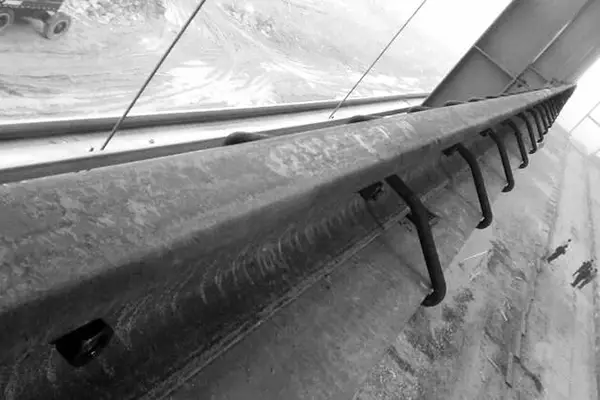


How to Prevent Hook Deformation During Concrete Vibration?
Hook deformation (e.g., straightening or bending of the 90° hook) typically occurs due to excessive vibrational energy, improper support, or hook orientation mismatch. To prevent it:
- Use Reinforced Hook Design
- Specify forged (not bent) hooks with ≥1.5× bar diameter bend radius — improves ductility and fatigue resistance.
- For heavy vibration (e.g., bridge decks), opt for necked or double-hook designs to distribute stress.
- Secure Fixturing Before Pour
- Rigidly tie hook bolts to rebar cage or formwork using wire ties or U-clamps — never rely on friction alone.
- Ensure hooks are oriented perpendicular to vibration direction (typically parallel to rail axis) to minimize lateral whipping.
- Control Vibration Parameters
- Use internal vibrators with ≤50 mm head diameter and limit insertion time to 10–15 sec per point.
- Maintain ≥75 mm clear cover around hooks to avoid direct vibrator contact.
- Verify Concrete Workability
- Target slump of 100–150 mm — overly stiff mixes require excessive vibration, increasing hook stress.
✅ Pro Tip: For critical applications, conduct a mock-up pour with embedded strain gauges or post-pour visual inspection (via inspection ports) to validate integrity.
CONTACT US NOW
🔹 Why choose us?
✅ Precision-fit hook bolts — engineered to your rail & beam ✅ Rigorous quality control — ISO-certified production
✅ Competitive pricing & transparent costing ✅ Responsive support — technical review within 24h
📩 Get your custom quote fast — just share rail model & H-beam drawing.