
Chemical Anchor Bolts
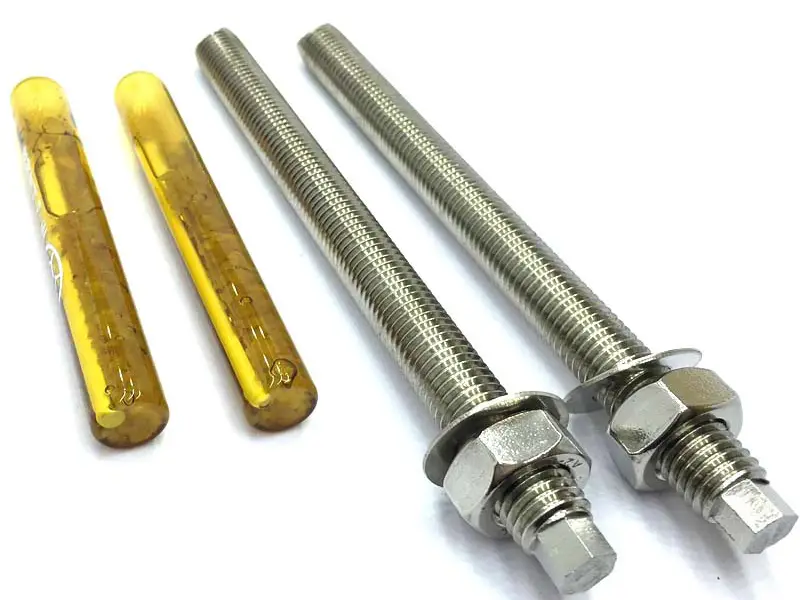
Chemical anchor bolts are advanced post-embedded anchoring materials, composed of chemical capsules, metal rods, washers, and nuts. They achieve stable bonding by using chemical adhesives to fix screws in drilled holes of concrete substrates, creating a strong composite connection between the anchored part and the fixed structure. Compared with traditional mechanical anchors, they offer superior seismic resistance and tensile performance. Their screws, washers, and nuts are available in galvanized steel or stainless steel (hot-dip galvanized optional), ensuring long-term durability in harsh environments. As a trusted rail material supplier, GloryRail’s chemical anchor bolts meet global quality standards and have been validated in numerous large-scale domestic and international projects.
Key Features of Chemical Anchor Bolts
✅ Excellent Chemical & Environmental Resistance – Resists corrosion from acids, alkalis, and other environmental factors. Performs reliably at low temperatures and demonstrates strong anti-aging properties against UV exposure and ozone.
⚙️ High Heat Resistance & Zero Creep at Room Temperature – Maintains integrity under elevated temperatures and exhibits no creep (plastic deformation) under constant load at ambient conditions, ensuring long-term dimensional stability.
🧱 Stable Performance in Humid & Water-Exposed Conditions – Impervious to water ingress, allowing for installation in wet conditions and ensuring stable long-term load-bearing capacity in damp or saturated environments.

📏 Weldable & Flame Retardant – The installed anchors can be welded to other structural elements without significant loss of strength. The formulation also provides inherent flame-retardant properties.
🛡️ Superior Shock and Vibration Resistance – Excellent performance in dynamic load and high-vibration applications, such as in seismic zones or on machinery, absorbing energy without loosening.
🧰 Reliable installation – Simple drill-clean-inject-insert-cure workflow ensures consistent performance when best practices are followed.
Applications of Chemical Anchor Bolts
Ideal for heavy-load fastening in narrow components or close edge distances (e.g., columns, balconies).
Suitable for use in concrete with a minimum strength class of C25.
Can be used in solid, load-bearing natural stone (verification required).
Common applications include:
Structural Steel: Rebar anchoring, metal components, support brackets.
Industrial: Machine base plates, plant equipment, pipelines, storage racks.
Infrastructure: Road guardrails, signage, noise barriers, railway sleepers.
Building Construction: Formwork, facade elements, windows, heavy doors.
Stainless steel (A4) anchors are recommended for outdoor, humid, industrial, or coastal environments.
Note: Galvanized and A4 stainless steel are not suitable for chloride-rich environments (e.g., indoor pools).
Effective for securing base plates with small spacings and multiple anchor points.


Installation Datasheet
| Anchor Bolt Size | Drill Hole Diameter (mm) | Drill Hole Depth (mm) | Bolt Length (mm) | Min. Base Material Thickness (mm) | Max. Fixed Material Thickness (mm) | Fixed Material Hole Diameter (mm) | Recommended Tightening Torque (Nm) | Tensile Design Value (kN) | Shear Design Value (kN) |
|---|---|---|---|---|---|---|---|---|---|
| M10 | 12 | 90 | 130 | 130 | 20 | 12 | 20 | 13.8 | 12.6 |
| M12 | 14 | 110 | 160 | 160 | 27 | 14 | 40 | 19.8 | 18.3 |
| M16 | 18 | 125 | 190 | 175 | 35 | 18 | 80 | 28.9 | 34.6 |
| M20 | 25 | 170 | 260 | 220 | 65 | 25 | 150 | 52.4 | 54.0 |
| M24 | 28 | 210 | 300 | 270 | 63 | 28 | 200 | 75.5 | 77.8 |
| M30 | 35 | 280 | 380 | 340 | 70 | 35 | 400 | 121.3 | 163.7 |
Curing Time Schedule
| Ambient Temperature (°C) | -5 | 0 | 5 | 10 | 20 | 30 | 40 |
|---|---|---|---|---|---|---|---|
| Gel Time | 30 min | 20 min | 14 min | 9 min | 5 min | 4 min | 2 min |
| Curing Time | 6 h | 3 h | 90 min | 70 min | 45 min | 25 min | 15 min |
Concrete Strength Adjustment Coefficient
| Concrete Grade | C25 | C30 | C35 | C40 |
|---|---|---|---|---|
| Coefficient | 0.95 | 0.1 | 1.05 | 1.10 |
Installation Guide for Chemical Anchor Bolts
Drill: Drill a hole to the required diameter and depth as per design specifications.
Clean: Thoroughly clean the hole using an air blower to remove all dust and debris.
Insert Capsule: Place the chemical capsule into the clean hole. Ensure the resin is fluid at hand temperature before use.
Set Bolt: Rotate the bolt into the hole using a drill (e.g., 750 rpm) until the chemical compound flows. This ruptures the capsule, mixing the components and filling the annular space.
For wet holes: Water must be displaced; gel and cure times must be doubled.
Gel Time: Keep the installation tool stationary for the specified gel time.
Cure Time: Remove the tool and allow the resin to fully harden for the specified cure time.
Secure: Once fully cured, attach the fixture with the washer and nut.
WHY CHOOSE US
20+ Years of Engineering Expertise
With decades of experience in anchoring and fastening solutions, our team provides professional guidance for complex construction and infrastructure projects.
Comprehensive Technical Support
From design consultation to on-site installation guidance, our engineers ensure that every chemical anchor bolt performs to its rated capacity and safety standard.
Certified Materials & Traceable Production
All anchor bolts are produced under strict quality systems, ensuring material traceability, mechanical property testing, and compliance with international standards.
Global Logistics & Reliable After-Sales Service
We deliver worldwide through efficient supply chains, offering responsive after-sales support and fast solutions for project-specific requirements.
FAQ:
Are there any temperature requirements for the construction of chemical anchor bolts?
Above -5℃, the impact is not significant. The chemicals should be placed indoors with proper insulation. Take as much as needed and use them up as soon as possible. After drilling holes and cleaning thoroughly, use the chemical anchor bolts again. Keep warm after use. The anchoring time is long. It is best to wait for 72 hours before proceeding with the next installation step to avoid failing to meet the anchoring strength.
How long after the chemical anchor bolts are pre-embedded can a pull-out test be conducted?
The complete curing time of chemical anchor bolts varies depending on the type of main resin. Specifically, it should be operated according to the time marked in the manual. Generally, for non-special cases, complete curing should be fine after 24 hours. Therefore, under non-special circumstances, it is more appropriate to conduct the pull-out test 24 hours after pre-burial. However, it is basically not advisable to conduct the pull-out test within 24 hours after pre-burial.
Contact Us Now
For more information or a customized quotation, please contact our technical team. Provide details of your project conditions — substrate, load, and environment — and we’ll recommend the most suitable chemical anchor bolt system for your application.