
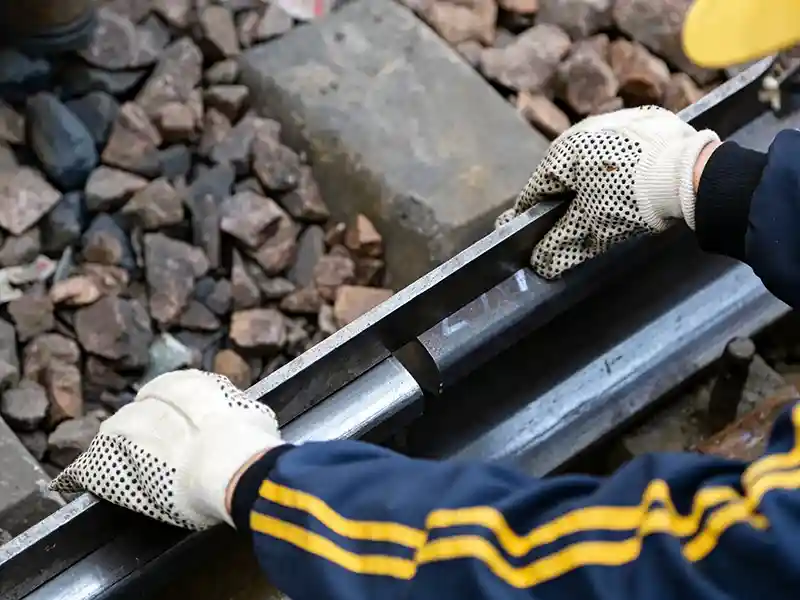
The fundamental challenge of railway engineering is a simple physical reality: steel expands and contracts. With a linear expansion coefficient of approximately 1.18×10⁻⁵/°C, a 100-meter rail can shift by nearly 60mm over a 50°C temperature swing. Left unmanaged, this thermal energy leads to track buckling in summer or rail breaks in winter—both catastrophic for safety. In the evolution of track design, the industry has moved from “releasing” this stress via gaps to “locking” it via Continuous Welded Rail (CWR). However, in complex structures like long-span bridges, the Rail Expansion Joints (REJ) remain the indispensable hero of track stability.
1. The Legacy Solution: Jointed Track and Its Limits
In traditional railway design, “rail gaps” were the primary method of thermal compensation. By calculating a specific gap size based on the local maximum and minimum rail temperatures (Tmax and Tmin), engineers allowed the rails to breathe.
While effective at releasing stress, this created the “clickety-clack” legacy of rail travel. For modern logistics, these joints are a liability:
- Maintenance Heavy: Impact loads at the joints account for over 60% of total track maintenance costs.
- Speed Restrictions: Jointed tracks generally cannot support speeds exceeding 160km/h due to dynamic instability.
- Component Fatigue: Constant impact pulverizes ballast and leads to “saddle-shaped” wear on the rail ends.
2. The Rise of Continuous Welded Rail (CWR)
Modern high-speed and heavy-haul lines utilize CWR, where rails are welded into lengths of several kilometers. Instead of allowing the rail to move, the rail is “locked” to the sleepers at a specific Neutral Rail Temperature (NRT) or “Locking Temperature.”
Under CWR, thermal expansion is converted into internal longitudinal stress. For a standard 60kg/m rail, every 1°C change in temperature creates about 2.5MPa of internal stress. Since modern steel has a yield strength far exceeding these thermal loads, the rail remains safe—provided the track bed provides enough lateral resistance to prevent buckling (the dreaded “sun kink”).
3. When CWR Isn’t Enough: The Role of Rail Expansion Joints (REJ)
While CWR handles the majority of the mainline, certain “special structures” cannot be fully locked. This is where Rail Expansion Joints (REJ)—often called telescopic or sliders—come into play. They act as a controlled, high-precision interface that allows for significant longitudinal movement while maintaining a continuous running surface for the wheels.
Key Applications:
- Long-Span Bridges: Bridges longer than 120m expand and contract independently of the track. If the rail were fixed rigidly to a large bridge, the bridge’s movement would snap the rail or crush the fasteners. An REJ at the bridge abutment decouples the rail from the bridge’s thermal movement.
- Turnout Zones: Switches and crossings are complex mechanical assemblies sensitive to stress. REJs are often placed before and after major turnout sections to isolate them from the massive longitudinal forces of the adjacent long-welded rails.
4. Technical Requirements for Modern REJs
An REJ is not just a gap; it is a precision-engineered component. To ensure safety at high speeds, they must meet rigorous standards:
- Geometric Precision: The surface planarity must be kept within 1mm over a 3m span to prevent impact forces.
- High Stroke Capacity: Depending on the bridge length, REJs are designed for expansion ranges of ± 200mm to ±500mm or more.
- Debris Protection: Because they rely on sliding components (like stock rails and switch rails), they must be protected from dust and water to prevent seizing.
5. Looking Ahead: Precision Manufacturing for Custom Infrastructure
As railway networks push into more extreme environments—from high-altitude cold zones to humid coastal crossings—the demand for bespoke track solutions has never been higher. Standard off-the-shelf components rarely suffice for unique bridge designs or heavy-duty industrial sidings.
Glory Rail understands that every project has its own unique thermal profile and load requirements. Whether you are designing a high-speed line or a heavy-haul industrial terminal, we provide customized rail processing and manufacturing services. From specialized rail expansion joint assemblies to high-precision machining for unique track layouts, our engineering team ensures your infrastructure is built to handle the stress.