
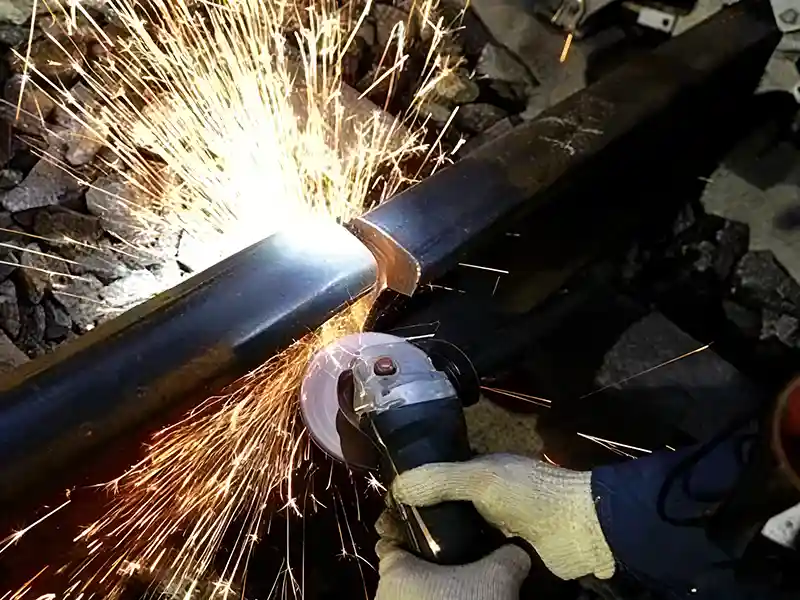
Railway rails are not fully welded together because steel expands and contracts with temperature changes. If rails were completely fixed with no flexibility, they could buckle in hot weather or crack in cold conditions, creating serious safety risks. Modern railways solve this problem by using controlled welding systems, not by eliminating movement entirely.
The Real Reason: Steel Always Moves
All railway rails are made of steel, and steel reacts to temperature.
Even small temperature changes can create significant movement over long distances:
- Expansion coefficient of steel: about 11.5 × 10⁻⁶ /°C
- A 1000-meter rail can expand by over 1 meter under large temperature differences
- A 1°C change can generate around 1.6 tons of force per meter
This means railway rails are constantly under internal stress.
If that stress has nowhere to go, the result is predictable:
- In summer → track buckling
- In winter → rail fractures
Traditional Solution: Leaving Gaps Between Railway Rails
In early railway systems, engineers handled this problem in a simple way:
they did not fully weld railway rails together.
Instead, rails were installed in short sections (typically around 25 meters), with small gaps between them.
Advantages:
- Allows free expansion and contraction
- Prevents stress buildup
Disadvantages:
- Noticeable noise and vibration (“click-clack” sound)
- Increased wheel and rail wear
- Lower ride comfort
This system worked, but it was far from ideal—especially for modern high-speed rail.
Modern Approach: Continuously Welded Railway Rails (CWR)
Today, most mainline and high-speed railway rails are welded into long, continuous tracks.
But importantly, they are not completely rigid.
Engineers use a controlled system known as Continuously Welded Rail (CWR).
1. Long Rail Welding
Short railway tracks are welded into lengths of hundreds of meters or even several kilometers, reducing the number of joints.
2. Neutral Temperature (Stress Locking)
Rails are installed at a specific temperature—called the neutral temperature.
This ensures:
- Summer expansion and winter contraction remain within safe limits
- Internal stress is balanced rather than eliminated
3. Strong Fastening and Track Structure
Railway tracks are fixed with:
- High-strength fasteners
- Dense ballast or concrete track systems
These provide enough resistance to control movement without fully preventing it.
Why Railway Rails Still Can’t Be Fully Welded
Even with modern technology, railway rails cannot be completely welded into a single rigid structure.
There are several practical reasons:
1. Expansion Must Be Managed Somewhere
Long sections of railway tracks still need transition zones to absorb movement.
2. Bridges and Special Structures Move
Bridges expand, contract, and even shift slightly.
They require rail expansion devices to accommodate additional movement.
3. Maintenance Is Unavoidable
Railway rails need inspection, replacement, and repair.
A fully welded, non-adjustable system would make maintenance extremely difficult.
4. Welding Has Limits
Even advanced welding methods:
- Cannot perfectly match base metal properties
- May introduce defects or residual stress
Over very long distances, these small weaknesses can accumulate.
The Key Idea: “Welded, But Not Locked”
Modern railroad rails are designed with a balance in mind:
- Fewer joints for smoother and faster travel
- Controlled flexibility for safety and durability
Instead of asking whether railway rails should be fully welded, engineers focus on how to manage thermal stress safely and efficiently.
Quick FAQ
Do modern railway tracks still have gaps?
Yes, but only in specific locations such as bridges, turnouts, and transition zones.
What happens if railroad rails are fully fixed?
They can buckle in high temperatures or break in low temperatures.
Why are welded railway tracks better?
They reduce noise, improve ride comfort, and allow higher train speeds.
Conclusion
Railway rails are not fully welded together because movement is unavoidable. The goal of modern railway engineering is not to eliminate expansion, but to control it.
That’s why today’s railway rails are longer, smoother, and more advanced —— yet still carefully designed to handle the forces of nature.