
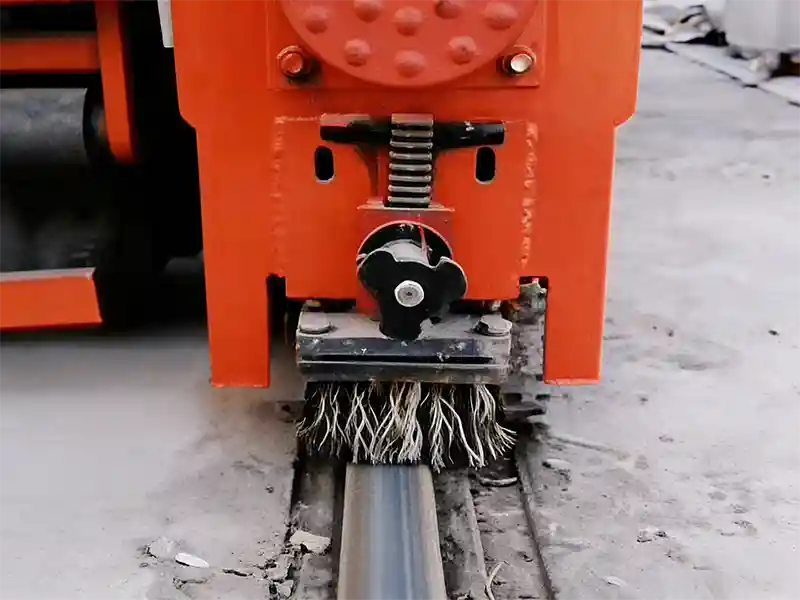
Crane rail sweepers are essential safety features that are mounted on gantry and overhead cranes. They are made to clear foreign objects, scale, and debris from rail surfaces. These devices have a direct influence on wheel and rail lifetime, operating stability, and derailment avoidance in heavy industrial environments including steel mills, foundries, and mining operations. For use in difficult environments, this article offers a thorough technical analysis of crane rail sweeper types, operating principles, design concerns, and maintenance techniques.
1. Introduction
In industrial material handling operations, crane runway rails are constantly exposed to contaminants including mill scale, ore dust, metal shavings, grease, and miscellaneous debris. When left unaddressed, these foreign materials cause:
- Accelerated component wear: Crushed debris acts as abrasive paste between wheels and rails
- Safety hazards: Large objects can cause derailment; slippery surfaces impair braking and positioning accuracy
- Structural damage: Accumulated material impacts rail clips, fishplates, and support structures
Crane rail sweepers serve as the first line of defense in preventive maintenance, mandatory under most crane safety regulations and essential for continuous production operations.
2. Classification of Crane Rail Sweepers
2.1 Fixed Blade Sweepers
- Construction: Rigidly fixed to an angle bracket in front of the wheel is a wear-resistant blade made of polyurethane, rubber, or spring steel.
- Operating principle: Just pushes loose material off the rail using the action of the crane.
- Benefits: Low cost and easy construction.
- Limitations: Rapid blade degradation; no wear adjustment; ineffective against sticky materials.
- Applications: Clean spaces such as light assembly shops or warehouses.
2.2 Spring-Loaded Rail Sweepers
- Construction: Spring mechanisms (coil springs or torsion bars) maintain constant blade pressure against the rail surface.
- Operating principle: Spring force ensures the scraper follows rail undulations and irregularities, effectively removing lightly sintered materials like mill scale.
- Advantages: Consistent cleaning performance; suitable for heavy-duty cycles; self-adjusting for wear.
- Considerations: Proper spring tension is critical—excessive pressure accelerates wear, insufficient pressure reduces effectiveness.
- Applications: Primary choice for steel mills, foundries, and heavy fabrication shops.
2.3 Composite Brush-Scraper Systems
- Construction: Combines rotating brushes (motorized or free-spinning) with a trailing scraper blade.
- Operating principle: Two-stage cleaning process:
- Brushes (steel wire or nylon) sweep fine dust and particles from the rail head
- Scraper blade removes remaining larger debris
- Advantages: Superior cleaning efficiency for all particle sizes; handles both coarse and fine contaminants.
- Limitations: Higher cost; more complex maintenance.
- Applications: Precision manufacturing facilities, automated warehouses with strict cleanliness requirements.
2.4 Magnetic Rail Sweepers
- Construction: High-strength magnets (electromagnetic or permanent neodymium) integrated into the sweeper assembly ahead of mechanical scrapers.
- Operating principle: Magnetic force actively attracts and removes ferrous contaminants—welding spatter, wire rope fragments, nails, iron fines—before mechanical scraping occurs.
- Advantages: Essential for ferrous debris that scrapers cannot handle; prevents metal fragments from embedding in wheels or rail.
- Variants: Electromagnetic types offer controllable magnetism; permanent magnets require mechanical stripper plates for cleaning.
- Applications: Welding shops, steel scrap yards, slag processing areas.
2.5 Combined Wind-Resistant Sweepers
- Construction: Integrated with rail clamps or anchor systems on large outdoor cranes.
- Operating principle: During high winds or emergency stops, the sweeper applies increased downward pressure, simultaneously cleaning the rail and providing supplementary braking friction.
- Applications: Large ship-to-shore gantry cranes, outdoor stockyard bridges.
3. Technical Design Considerations
3.1 Environmental Factors
| Environment | Material Requirements |
|---|---|
| High temperature (steel ladle handling) | Heat-resistant polyurethane, aramid composites, or metal blades |
| Low temperature (outdoor yards) | Cold-tolerant elastomers to prevent brittle fracture |
| Corrosive (chemical plants, saltwater ports) | Stainless steel hardware, chemically resistant blade materials |
3.2 Rail Interface Compatibility
The sweeper must clean the full rail head width without interfering with:
- Rail clips and fasteners
- Fishplates (joint bars)
- Switch points and crossings
Critical design feature: Adequate obstacle clearance through spring compression or mechanical stops.
3.3 Installation Configuration
- Bi-directional operation: Sweepers required on both sides of wheels for reversing cranes
- Positioning: Mounted directly ahead of load wheels to ensure clean rail contact
3.4 Maintenance Accessibility
- Wear indicators or visible wear limits
- Tool-less or quick-change blade retention
- Easily accessible tension adjustment mechanisms
3.5 Anti-Fouling Design
In environments with ropes, strapping, or packaging materials:
- Smooth profiles without projections
- Enclosed pivot points
- Prevention of material wrapping and accumulation
4. Installation and Maintenance Guidelines
4.1 Initial Setup
- Contact pressure: Adjust for light, uniform contact across the rail head
- Verification methods: Feeler gauges or witness marks (chalk test)
- Spring preload: Set according to manufacturer specifications for the specific crane duty cycle
4.2 Routine Inspection
| Frequency | Check Points |
|---|---|
| Daily | Visual blade wear, accumulated debris piles ahead of sweeper |
| Weekly | Spring tension, fastener torque, alignment |
| Monthly | Structural integrity, wear pattern analysis |
4.3 Replacement Criteria
- Blade worn to wear limit indicator
- Exposure of metal backing plate
- Uneven wear patterns indicating misalignment
- Cracking or chunking of elastomer
4.4 Debris Management
Manually clear accumulated material “snowplow” piles before they obstruct crane travel or become secondary hazards.
5. Selection Guidelines by Industry
| Industry | Primary Contaminants | Recommended Sweeper Type |
|---|---|---|
| Steel production | Mill scale, slag, iron fines | Spring-loaded + magnetic |
| Cement plants | Clinker dust, limestone | Composite brush-scraper |
| Coal handling | Coal dust, frozen lumps | Heavy-duty spring-loaded |
| Automotive stamping | Metal stamping scrap | Magnetic + fixed blade |
| Foundries | Sand, flash, metal spatter | Spring-loaded + replaceable tips |
| Paper mills | Debris, moisture | Corrosion-resistant spring-loaded |
6. Conclusion
While often viewed as a simple accessory, the crane rail sweeper is vital for protecting wheel-rail interfaces and ensuring heavy machinery safety. Proper selection and scientific maintenance are key to maximizing equipment uptime.
High-performance crane rail sweepers that meet different industrial rail requirements are Glory Rail‘s area of expertise. We offer the hardware and technical know-how to keep your crane systems operating efficiently, whether you need heavy-duty spring-loaded scrapers for steel mills or unique solutions for automated tracks.