
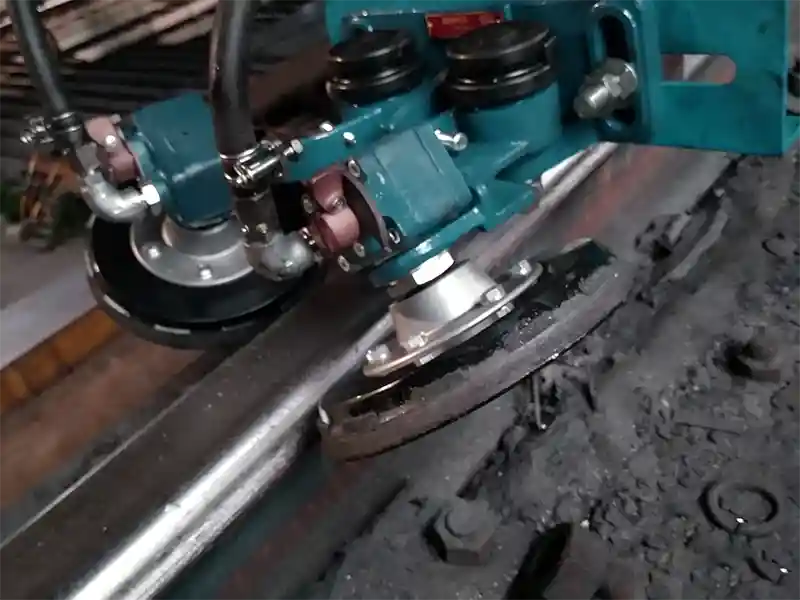
1.Introduction
Rail lubrication is a critical maintenance strategy for heavy-haul railways, which are characterized by high axle loads, massive traffic volumes, and frequent small-radius curves. In systems like China’s Daqin Railway, the lateral wear of rails in curved sections poses a significant challenge to operational safety and cost-efficiency. By introducing a lubricant at the wheel-rail interface, the friction coefficient can be reduced from dry levels (up to 0.8) to optimized ranges, significantly extending the service life of both rails and wheelsets.
2.Tribological Mechanism and Requirements
The wheel-rail contact is a complex rolling-sliding system. To balance traction and wear, different friction targets are required for different contact zones:
- Top of Rail (TOR): Requires a controlled friction coefficient (0.3 to 0.35) to ensure effective braking and traction.
- Gauge Face/Wheel Flange: Requires the lowest possible friction (<0.2) to prevent “gouging” or severe lateral wear.
Research indicates that rail damage primarily includes cutting wear, rolling contact fatigue (RCF), and adhesive wear. Effective lubrication creates a low-shear boundary film that can reduce field wear rates by 42% to 56% in heavy-haul environments.
3 Classification of Lubrication Systems
3.1 Wayside Rail Lubricators
Wayside units are stationary systems installed at specific high-wear locations like sharp curves or switches.
- Mechanism: Sensors detect an approaching train, triggering a hydraulic or pneumatic pump to deliver grease through applicators mounted on the rail.
- Optimal Parameters: Data from the Daqin line suggests an optimal flow rate of 0.7 mL/s for a duration of 8 seconds per train to ensure coverage without waste.
3.2 On-Board (Vehicle-Borne) Lubricators
Mounted on the locomotive or bogie, these systems spray atomized lubricant directly onto the wheel flange using compressed air.
- Advantage: Provides continuous coverage across the entire network.
- Intelligence: Modern systems use GPS or gyro-sensors to identify curves, ensuring lubricant is only applied where needed to protect the TOR’s adhesion.
3.3 Comparative Summary
| Feature | Wayside Lubricators | On-Board Lubricators |
| Best Use Case | Localized “hotspots” (sharp curves) | Full-line systemic protection |
| Maintenance | Concentrated at specific track points | Distributed across rolling stock |
| Precision | High volume at specific contact points | Fine mist, high-frequency application |
4 Key Technical Elements
4.1 Precision Control and Smart Logic
Over-lubrication is as detrimental as under-lubrication, as excess grease can migrate to the rail head, causing wheel slip. Modern units integrate:
- Vibration & Noise Sensors: To detect “wheel squeal” and adjust dosage dynamically.
- IoT Connectivity: For remote monitoring of tank levels and equipment health.
4.2 Lubricant Performance
Rail-specific lubricants must withstand extreme pressures (EP properties) and resist “fling-off” from high-speed centrifugal forces. Many formulations utilize solid additives like Molybdenum Disulfide (MoS_2) or Graphite to maintain a protective layer even after the wet carrier has worn away.
5.Glory Rail: Leading the Way in Friction Management
Effective rail lubrication is no longer just about applying grease; it is about “Total Friction Management.” At Glory Rail, we specialize in high-performance rail solutions designed to withstand the rigors of heavy-haul operations.
Our Glory Rail Lubricator systems are engineered for precision and durability. Whether you require a wayside electronic lubricator for sharp curves or a hydraulic solution for remote areas, our products ensure:
- Reduced Lateral Wear: Extending rail life by up to 50%.
- Energy Efficiency: Lowering train resistance to save on fuel costs.
- Environmentally Robust Design: IP65-rated components that operate from -40°C to +70°C.
By choosing Glory Rail products through railroadtrackforsale.com, you are investing in the longevity of your infrastructure and the safety of your operations.