
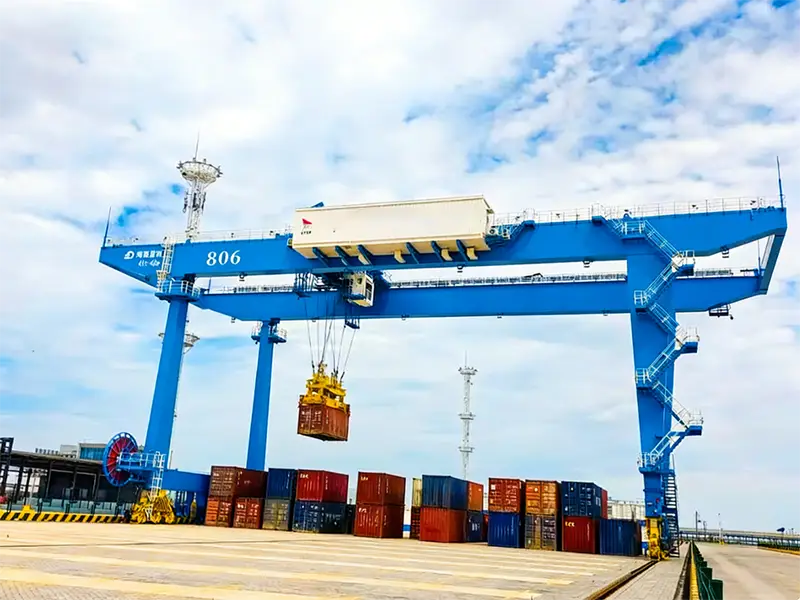
Crane rail wear is a common issue in container and bulk terminals, where rails are exposed to heavy loads, frequent start-stop operations, and corrosive marine conditions. If not controlled, it can lead to misalignment (rail gnawing), increased vibration, accelerated wheel wear, and even foundation problems. This article focuses on the main wear types, underlying mechanisms, inspection methods, and practical measures to extend the service life of crane rail systems.
I. Categorizing Crane Rail Wear: Visual Signatures and Diagnostic Indicators
Identifying the type of wear is the first step in root-cause analysis. Field teams can often categorize damage through visual inspection and precision measurement.
1. Vertical Wear: The Load-Bearing Burden
Vertical wear occurs at the rail head’s top surface, where the wheel tread makes primary contact.
- Uniform Wear: A gradual thinning of the rail head. This is typical for well-maintained systems with balanced loading.
- Localized Pitting: Depressions or “pockmarks” often caused by surface contaminants or instantaneous impact loads (e.g., snagged loads or wheel skidding).
- Corrugation: Periodic wave-like patterns (wavelengths of 50–200mm). This is frequently a result of wheel-rail resonance and can accelerate the destruction of the crane’s travel mechanism.
2. Lateral (Side) Wear: The Friction of Misalignment
This focuses on the inner or outer sides of the rail head. It is the “smoking gun” for tracking issues.
- Light Wear: Polished metal surfaces without significant dimensional loss.
- Heavy Wear: Visible “steps” or gouges where the wheel flange has aggressively ground into the rail. This indicates a severe “rail gnawing” problem that requires immediate geometry correction.
3. Fatigue and Environmental Damage
- Spalling: Large flakes of metal peeling away from the surface. This isn’t just surface friction; it’s a sign that internal stresses have exceeded the material’s fatigue limit.
- Corrosion-Wear Synergy: In port environments, salt spray creates a rust layer that acts as an abrasive. The cycle of “rust-grind-rust” thins the rail much faster than mechanical friction alone.
II. The Science of Degradation: Core Mechanisms
Understanding why the steel fails allows for better material selection and operational adjustments.
- Contact Fatigue: Port cranes operate in a constant loop of acceleration and braking. This cyclic loading creates sub-surface micro-cracks. Eventually, these cracks migrate to the surface, leading to “shelling” or internal fractures that are invisible to the naked eye.
- Abrasive Wear: Port yards are often dusty. Sand, iron ore dust, or coal fines act as “grinding paste” between the wheel and rail, drastically increasing the rate of material loss.
- Impact Loading: Gaps at rail joints or uneven foundations cause the crane to “jump.” This creates high-velocity impacts that lead to plastic deformation—where the rail head actually flattens or mushrooms out.
III. Professional Diagnostic & Testing Framework
A robust maintenance program relies on a three-tier diagnostic approach to ensure no “hidden” flaws lead to catastrophic failure.
1. Geometric Inspection (The Baseline)
Standard maintenance should include periodic checks using the following parameters:
- Span/Gauge Deviation: Must generally be kept within ±3mm to prevent lateral flange contact.
- Straightness: A deviation of more than 1mm per meter can trigger erratic crane behavior.
- Vertical Loss: Once wear exceeds 10% of the original rail head height, the structural integrity is compromised.
2. Non-Destructive Testing (NDT)
For older rails, visual checks aren’t enough.
- Magnetic Particle Testing (MPT): Excellent for finding tiny surface cracks.
- Ultrasonic Testing (UT): The industry gold standard for detecting internal voids or cracks in the rail web and base that could lead to a sudden snap.
| Metric | Tool | Target Tolerance |
| Span Gauge | Rail Gauge Ruler | ≤ ±3mm |
| Straightness | Laser Tracker/Wire | ≤ 1mm/m |
| Vertical Wear | Vernier Caliper | < 10% Height |
IV. Life-Extension Strategy: A Closed-Loop Approach
To maximize the ROI of your rail infrastructure, terminal managers should adopt a “closed-loop” practice spanning from procurement to daily ops.
1. Material Selection: Hardness and Chemistry
Don’t settle for standard steel in high-throughput zones. Opting for high-carbon, low-alloy rails like U71Mn or QU120 provides better resistance to both wear and deformation. Ensure the rail hardness is slightly higher than the wheel hardness to prevent the rail from being the “sacrificial” component.
2. Installation Precision
The lifespan of a rail is often decided during the first week of installation. Ensuring that rail joints are perfectly leveled (mismatch ≤ 1mm) and that the soft-mount pads are correctly seated will prevent 70% of future impact-related wear.
3. Advanced Lubrication
Lateral wear can be reduced by up to 50% through targeted lubrication. Modern systems use solid-state lubricants or automatic flange lubricators. Note: Never lubricate the top of the rail, as this reduces the friction needed for braking and travel.
4. Operational Controls
Training operators to avoid “plugging” (sudden reversing) and excessive rapid acceleration reduces the horizontal shear stress on the rail mounting clips and the rail surface itself.
V. Conclusion: Data-Driven Rail Management
Modern port management is moving toward “digital twin” or data-logged maintenance. By recording wear rates every six months and mapping them against TEU throughput, terminal engineers can predict exactly when a rail section will reach its limit. This allows for planned replacements during low-tide or off-peak windows, rather than scrambling during a breakdown.
Investing in high-quality crane rails and rigorous diagnostic protocols isn’t just a maintenance expense—it is a strategic move to ensure the terminal remains a reliable link in the global supply chain.