
1. Introduction
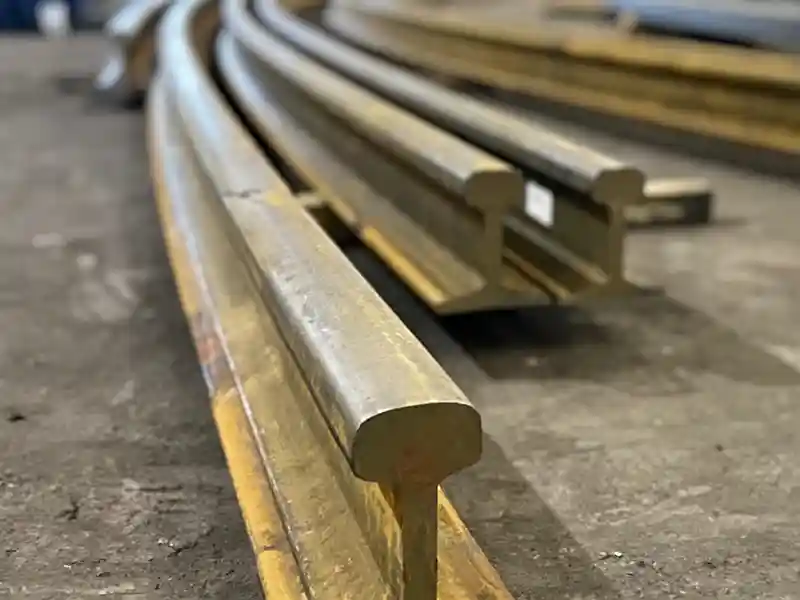
Railway lines are not ideally straight. Due to terrain, urban planning, and operational constraints, curved tracks are inevitable. As the component that directly supports and guides trains, rails must precisely match the geometric shape of the track. Therefore, the rail bending process directly affects the geometric accuracy of the track, the passing performance of trains, and passenger comfort. With the development of high-speed and heavy-haul railways, higher demands are placed on the precision and efficiency of rail bending.
2. Process Objectives and Application Scenarios of Rail Bending
The core objective of rail bending is to induce irreversible plastic deformation in the rail to achieve the required curvature. The main application scenarios include:
- Curved Track Laying: Bending standard-length rails to an arc consistent with the designed curve radius (e.g., R=400m, R=10000m) is a prerequisite for laying curved tracks.
- Turnout Area Connections: Components within turnouts (switches), such as stock rails, switch rails, and frog rails, possess complex spatial geometries that require precise bending and twisting.
- Rail Straightening: Correcting minor deformations in rails caused by manufacturing, welding, transportation, or service to restore straightness. This is essentially the reverse application of the bending process.
- Special Applications: Such as forming crane runways, amusement ride tracks (e.g., roller coasters), and architectural decorative elements.
3. Core Technical Classifications of Rail Bending
Based on the temperature of the rail during processing, rail bending is mainly divided into two categories: cold bending and hot bending.
| Characteristic | Cold Bending Process | Hot Bending Process |
|---|---|---|
| Temperature Condition | Ambient temperature (room temperature) | Heated above the austenitizing temperature (typically >900°C), rail is in a red-hot state |
| Deformation Mechanism | Under external force, metal grains slip internally, causing work hardening | At high temperatures, the yield strength of the metal decreases sharply, and plasticity increases significantly, making it easy to form |
| Applicable Scenarios | Larger bending radii (e.g., R>300m), conventional track laying and straightening; the most widely used method | Extremely small bending radii (e.g., R<200m), complex special components (e.g.,某些 turnout switch rails) |
| Advantages | Simple process, relatively low cost, high production efficiency; largely preserves the original mechanical properties of the steel | Very high plasticity, less prone to cracking; lower residual stress after forming |
| Disadvantages & Challenges | Generates residual stress, may require subsequent stress relief processes (e.g., vibratory stress relief); high demands on equipment power and rigidity | Complex process, requires precise temperature control; otherwise, it can easily lead to steel decarburization, grain coarsening, and reduce rail service performance |
4. Core Equipment and Process Methods
The realization of rail bending relies on specialized mechanical equipment, whose principles all involve applying concentrated loads to induce bending deformation in the rail.
- Hydraulic Rail Benders:
- Principle: Based on the three-point bending or four-point bending principle. Hydraulic cylinders provide power, using a ram or die to apply pressure on specific points of the rail, causing it to bend around two support points.
- Application: The most common equipment used in on-site operations and factory prefabrication. Models range from light manual hydraulic types to large CNC hydraulic types.
- Technical Progress: Modern high-end hydraulic rail benders integrate displacement sensors and pressure sensors to monitor the position and load at loading points in real-time. They achieve precise loading through computer control systems, effectively controlling and utilizing spring-back to achieve “one-step forming” or high-precision multi-step forming.
- Roller Rail Benders:
- Principle: Consists of a series of rollers arranged in a specific pattern (typically three or four rollers). The rail passes continuously between the rollers. By adjusting the spacing and relative positions of the rollers, the rail experiences a continuous bending moment as it travels, gradually bending into the required arc.
- Application: Suitable for high-volume, continuous bending of long rails. High production efficiency, commonly used for pre-bending long rails at welding bases.
- Comparison of Three-Point and Four-Point Bending Processes:
- Three-Point Bending: Simple structure, lower equipment cost, but prone to stress concentration at the loading point, affecting bending quality, and difficult to precisely control large arcs.
- Four-Point Bending: Creates a pure bending zone between the two loading points where the bending moment is uniform. This achieves a more uniform and precise arc curvature. For processing switch rails in high-speed railway turnouts, which can be tens of meters long and have varying curvature, the four-point bending process shows significant advantages.
5. Process Workflow and Quality Control
A complete rail bending process workflow typically includes the following steps:
- Preparation and Calculation:
- Obtain track design documents, clarifying parameters like bending radius (R), curve length, chord length, etc.
- Based on the rail material (e.g., U71Mn, U75V) and section modulus, calculate the material’s elastic modulus and yield strength using mechanical models to predict spring-back. Compensating for spring-back is a critical parameter that must be accurately accounted for in the bending process.
- Combine with equipment capabilities to determine loading positions, loading sequence, and loading forces.
- Precision Bending Operation:
- Correctly position the rail on the working supports of the rail bender.
- Apply pressure step-by-step according to the preset program. Allow a short holding time after each loading step to relieve some internal stress.
- In high-precision operations, total stations or specialized track geometry measurement instruments are used to monitor the rail during bending in real-time, comparing it with the theoretical geometry.
- Quality Inspection and Acceptance:
- Geometric Dimension Inspection: Use universal track gauges, string lines, or laser alignment devices to measure the versine and curvature radius after bending, ensuring errors are within permissible limits (e.g., ±1mm/10m).
- Surface Quality Inspection: Visually or with magnification aids, inspect the rail head, base, and web for cracks, folds, or indentations. For critical components, magnetic particle testing (MT) or ultrasonic testing (UT) is required to rule out surface and internal micro-cracks.
- Hardness and Metallographic Examination (Sampling): Especially for hot-bent pieces, sample and check hardness changes and microstructure to confirm that the heating and forming process did not adversely affect steel performance.
6. Technological Innovation and Outlook
Currently, rail bending technology is moving towards intelligence, precision, and green development:
- Digital Design and Simulation: Using finite element analysis software to simulate the entire bending process on a computer, predicting stress, strain, and spring-back. This optimizes process parameters and reduces on-site trial-and-error costs.
- Automation and Robotics: Combining machine vision and industrial robots to achieve automatic loading, positioning, bending, and unloading of rails, significantly improving production efficiency and operational safety.
- High-Frequency Induction Heating Bending: As an efficient local heating method, it is being explored for scenarios requiring small-radius local bends, ensuring plasticity while minimizing the thermal impact on overall performance.
Conclusion
Rail bending may seem like a traditional metal forming process, but it actually embodies a multidisciplinary application of material science, mechanics, mechanical engineering, and automation control. It is not merely about changing the shape of the rail, but precisely shaping the track geometry while ensuring its internal quality and service performance. As railways evolve towards higher speeds and greater loads, the demands on the precision, efficiency, and reliability of rail bending technology will become even more stringent, driving continuous innovation and breakthroughs in this field.
For railway projects requiring high-precision curved rails, specialized turnout components, or custom track processing services, please feel free to contact us. Our team provides professional rail products and tailored solutions to meet your specific engineering needs.