
1. Introduction
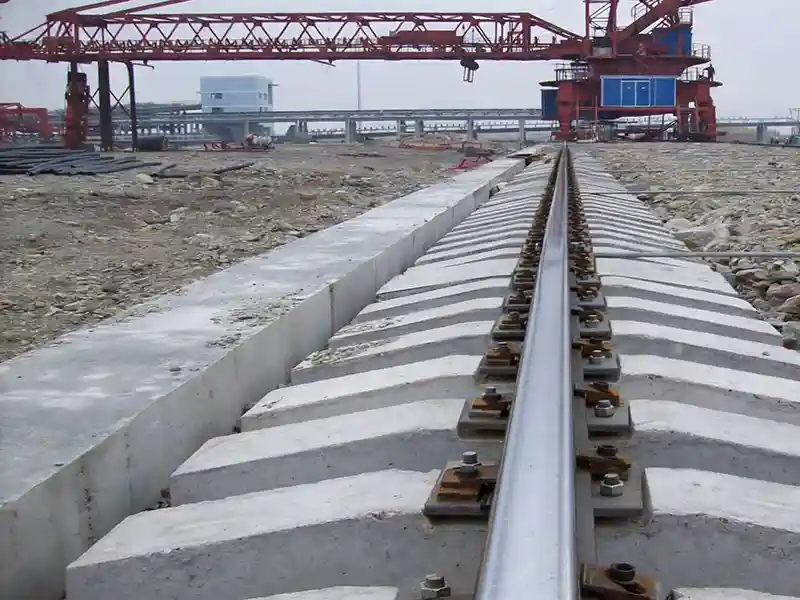
As the core equipment for port handling operations, the reliability of a crane’s runway fixing system is paramount to operational safety and efficiency. Rail clips for cranes are the critical components that connect the rail to the supporting foundation, responsible for transferring loads, maintaining gauge, and absorbing dynamic impacts.
Currently, two main technological approaches exist for rail clip systems in port applications: the traditional Rigid Fixing System, which uses non-yielding clips, and the Flexible Fixing System, which has gained prominence since the early 2000s and utilizes adjustable components with elastic elements. This paper will conduct an in-depth technical analysis of both systems, with a specific focus on the rail clip itself.
2. System Structure and Design Principles
2.1 Structural Characteristics of the Rigid Rail Clip System
The basic components of a rigid rail clip system are:
- Rigid Rail Clip: Typically made of cast or forged steel, it maintains rigid, metal-to-metal contact with the rail foot.
- Anchor Bolts: The clip is mounted directly onto these pre-embedded bolts, which bear all forces transmitted from the clip.
- Rail Joints: Fishplates and bolts are used to connect rail sections.
Design Principle: The rail is fixed to the foundation via a rigid clip. Loads generated during crane operation are transferred directly through a short, concentrated path: Rail → Rigid Clip → Anchor Bolt → Concrete Foundation.
2.2 Structural Characteristics of the Flexible Rail Clip Assembly
The flexible system features a more sophisticated, multi-component rail clip assembly:
- Clip Jaw (Upper Clamp): The part that contacts the rail foot, often integrated with an elastic element.
- Elastic Nose (Rubber Pad): Made of synthetic styrene-butadiene rubber (SBR), formed through a high-temperature vulcanization process that ensures bond strength exceeds the rubber’s own tensile strength.
- Clip Base (Lower Plate): Welded directly onto a steel soleplate. It features a wedge-shaped interface that mates with the clip jaw.
- High-Strength Bolt: Grade 8.8 bolts are used, with a minimum tensile strength of 800 MPa and hardness of 242-318 HB.
- Steel Soleplate: This is the key component that decouples functions. The anchor bolts fix only the soleplate to the foundation, while the clip base is welded to it.
Design Principle: The system separates the clamping function from the anchoring function. It utilizes an elastic element for cushioning and a wedge-shaped interface to optimize the load path.
3. Technical Comparison of Rail Clip Systems
3.1 Structural Comparison of Rail Clips
| Comparison Item | Rigid Rail Clip | Flexible Rail Clip Assembly | Technical Insight |
|---|---|---|---|
| Clip Material | Cast/forged steel; rigid contact | Clip jaw + SBR rubber nose | Vulcanized rubber pad absorbs tolerances and provides damping. |
| Contact Type | Steel-on-steel, rigid | Steel-on-rubber-on-steel, elastic | Elastic contact mitigates impact and accommodates minor misalignments. |
| Installation | Clip mounted directly on anchor bolt | Base welded to soleplate; jaw bolted to base | Functional separation optimizes the load path and protects bolts. |
| Adjustability | None | Lateral adjustment of the clip jaw | Ensures all clips make firm, even contact with the rail foot for shared load distribution. |
3.2 Comparison of Load Transfer Mechanisms
3.2.1 Load Path in Rigid Clip Systems
In a rigid system, the load path is direct and concentrated:
- Vertical Loads: Wheel load → Rail → Rigid Clip → Anchor Bolt → Concrete Foundation.
- Lateral (Horizontal) Loads: Wheel guidance force → Rail → The first clip contacted → Anchor Bolt → Concrete Foundation.
Critical Issues:
- Point Loading: Lateral forces are often resisted by a single clip. If this force exceeds the bolt’s pre-tension, the bolt can loosen.
- Complex Bolt Stress: The anchor bolt experiences a combination of tensile (from uplift) and shear (from lateral) forces, leading to high fatigue risk.
- No Load Sharing: The rigid connection prevents the effective distribution of lateral loads among multiple clips.
3.2.2 Optimized Load Path in Flexible Clip Systems
The flexible system introduces a longer, more intelligent load path:
- Lateral Loads: Wheel guidance force → Rail → Clip Jaw → Wedge-shaped interface → Clip Base → Weld → Steel Soleplate → Anchor Bolts → Concrete Foundation.
- Vertical Loads: Wheel load → Rail → Clip Jaw → Elastic Nose → Clip Base → (same path as above).
Optimization Mechanisms:
- Load Distribution: The steel soleplate acts as a load distributor, spreading the concentrated forces from the clip across multiple anchor bolts.
- Bolt Protection: The wedge-shaped interface is critical. Lateral force from the rail is transferred directly from the jaw to the base via this wedge. The clip bolt itself is largely isolated from shear forces, its primary role being to hold the jaw in place.
- Elastic Damping: The rubber nose absorbs high-frequency vibrations and shock loads, protecting the entire system from fatigue.
- Self-Locking: The wedge design creates a self-locking effect under load, preventing the clip jaw from loosening due to vibration.
3.3 Comparison of Rail Joints
| Comparison Item | Rigid System | Flexible System | Technical Impact |
|---|---|---|---|
| Joint Type | Fishplate and bolt connection | Welded rail, continuous length | Welding eliminates the geometric discontinuity at joints. |
| Joint Impact | Concentrated impact as wheels pass over the gap | No joint impact; smooth wheel transition | Impact causes rail end batter, fishplate loosening, and foundation degradation. |
| Thermal Stress | Accommodated by expansion gaps | Must be managed through welding procedures | Flexible system requires high-quality welding to prevent failure from thermal and load stresses. |
3.4 Comparison of Engineering Performance
| Performance Metric | Rigid System | Flexible System | Conclusion |
|---|---|---|---|
| Running Smoothness | Noticeable impact at joints | Smooth throughout | Flexible system is essential for high-speed, heavy-duty operations. |
| Maintenance Burden | High: Frequent bolt retightening, joint realignment, and repair. | Low: Long service life of elastic components. | Flexible system significantly reduces lifecycle maintenance costs. |
| Foundation Stress | Localized stress concentrations | Evenly distributed load | Flexible system prolongs the service life of the concrete foundation. |
| Adaptability | Fixed gauge, no adjustment | Adjustable clips accommodate rail tolerances and minor deformations. | Flexible system offers greater adaptability during installation and service. |
4. Key Technical Parameters
4.1 Elastic Element Specifications
The rubber nose is the heart of the flexible rail clip. Its key specifications are:
- Material: Synthetic Styrene-Butadiene Rubber (SBR)
- Manufacturing: High-temperature vulcanization and compression molding. This is a chemical bond, not simple gluing.
- Bond Strength: The bond strength is greater than the tensile strength of the rubber itself, ensuring long-term reliability.
- Functions: Compensates for manufacturing tolerances; dampens vibration to eliminate bolt fatigue stress; prevents bolt loosening; provides longitudinal restraint to the rail.
4.2 High-Strength Bolt Performance
The use of Grade 8.8 high-strength bolts in the flexible system is critical:
- Tensile Strength: ≥ 800 MPa
- Yield Strength: ≥ 640 MPa
- Hardness: 242~318 HB
This high performance, combined with the bolt being isolated from direct shear forces by the wedge design, ensures a robust and durable connection with a very low risk of fatigue failure.
5. Engineering Selection Recommendations
5.1 When to Choose Rigid Rail Clips
- Small to medium-sized cranes with operating speeds ≤ 30 m/min.
- Light to moderate duty cycles with low annual operation hours.
- Projects with high sensitivity to initial investment costs.
- Ports with dedicated teams for frequent, ongoing track maintenance.
5.2 When to Choose Flexible Rail Clips for Cranes
- Large container cranes, ship unloaders with operating speeds ≥ 60 m/min.
- Heavy to extremely heavy duty cycles with high-frequency operation.
- Automated terminals where smooth, reliable operation is critical.
- Projects focused on optimizing total lifecycle cost (LCC).
- New port construction or major track renovation projects.
6. Conclusion
Rigid and flexible rail clips for cranes exhibit fundamental differences in their design philosophy, load transfer mechanics, and overall performance. Rigid systems are simpler and have a lower initial cost, but are inherently limited by load concentration, high bolt stress, and the dynamic problems caused by rail joints. Flexible systems, through the use of an engineered rail clip assembly with elastic elements, a load-distributing soleplate, and an optimized wedge-shaped interface, effectively resolve these issues.
By protecting the anchor bolts from shear, damping impact loads, and ensuring even load distribution, the flexible rail clips for cranes is the superior technical solution for modern, high-performance port applications. The final choice should be based on a comprehensive evaluation of crane parameters, operational duty, and long-term maintenance strategies.