

In any industrial bay, the bridge crane tracks are literally the backbone of your operations. But let’s be honest: because they’re tucked away high on the runway beams, they are often “out of sight, out of mind” until a loud screeching sound or a jagged movement halts production.
Ignoring a worn bridge crane rail isn’t just a maintenance oversight—it’s a massive safety liability. Whether you are running a heavy-duty QU100 line or a lighter P-series setup, here is what you actually need to look for during your next inspection.
1. Pre-Check: Don’t Take Shortcuts
Before anyone climbs up that ladder, safety isn’t just a checkbox; it’s your life.
- Lock It Down: Never trust a remote. Physically cut the main power and use a proper lockout/tagout (LOTO) system.
- Tie Off Your Gear: I’ve seen enough dropped wrenches to tell you—tether every single tool. A falling 19mm spanner from 10 meters up is a lethal projectile.
- Stay Clipped In: If you’re walking the bridge crane rail, you need a 100% tie-off. No exceptions.
2. Choosing the Right Iron
Not all steel is created equal. Depending on your cycle times, you’re likely looking at one of two setups:
- The Workhorses (QU Series): Think QU70 or QU120. These are purpose-built for crane duty with a fat head and a beefy web to soak up those vertical loads.
- The Budget-Friendly (P Series): Standard railway profiles like 43kg/m or 50kg/m. Great for light to medium duty, but they’ll flatten out fast if you overload them.
Pro Tip: If you notice the rail head starting to “mushroom” (flatten out), your crane’s wheel pressure is likely too high for that specific rail grade.
3. The “Killers” of Crane Rails: Wear & Fatigue
When you’re up there inspecting the bridge crane tracks, don’t just look for cracks—look for the story the steel is telling you.
- Vertical Sinking: If the top of the rail has worn down by more than 10% (or roughly 3mm on a QU rail), it’s reaching the end of its life.
- Side Shaving: Is one side of the rail head shiny while the other is rusty? That’s “rail gnawing.” Your crane is fighting the track, and the track is losing.
- The “Washboard” Effect: Feel the surface. If it feels like a corrugated road (wavy wear), your crane will vibrate itself to death. You need to grind those ripples out before they crack your runway beams.
Internal Defects and Corrosion
- NDT Testing: For older tracks, use ultrasonic flaw detection to find internal “kidney defects” or white spots.
- Corrosion: In high-humidity or chemical environments, check the rail base (where it contacts the beam) for pitting that could weaken the cross-section.
4. Fasteners and Connection Components
The fastening system often fails before the bridge crane tracks themselves.
- Rail Clips & Bolts: Check for loose, bent, or broken clips. If using bolt-type clips, ensure spring washers are not flattened or fatigued.
- Fishplates (Joint Bars): Joint bolts (ideally Grade 10.9) must be tight. A minimum of 4 bolts is required, though 6 is standard for heavy applications.
- Rail Creep: If the gap between the rail end and the stop increases, the rail is “creeping.” Tighten fasteners or add anti-creep blocks.
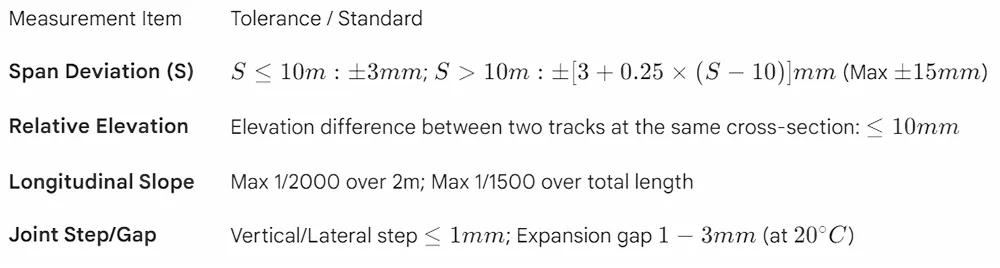
5. Geometric Measurement and Tolerance
Precise alignment of the bridge crane rail is essential for smooth operation.
6. Identifying “Rail Gnawing”
Check the sides of the bridge crane tracks for bright spots or metal burrs.
- One-sided brightness: Indicates the crane is skewing and the wheel flange is grinding against the rail.
- Dark/Light patches on top: Suggests wheel slipping or uneven loading.
- Solution: If detected, perform laser alignment of the tracks and check wheel parallelism.
Common Troubleshooting Summary
| Symptom | Possible Cause | Solution |
| Frequent Bolt Loosening | Excessive vibration / poor bedding | Use locking nuts or weld stop blocks |
| Transverse Rail Crack | Fatigue or material defect | Drill stop-holes and use fishplates or replace section |
| Intense Vibration | Joint steps or wavy wear | Grind joints or mill the rail surface |
Conclusion
The safety of bridge crane tracks is a meticulous task that directly impacts the operational lifespan of your crane and the safety of your facility. Monitoring trends in alignment data and wear patterns is just as important as the physical inspection itself.
At Glory Rail, we specialize in providing high-quality rail solutions, from standard P-series to heavy-duty crane rails. Our team doesn’t just sell “railroad track for sale”—we provide the technical expertise to ensure your overhead systems run straight and true.
Looking for high-performance rail materials or expert advice on track installation? [Contact Glory Rail today] for a customized quote and professional consultation.