
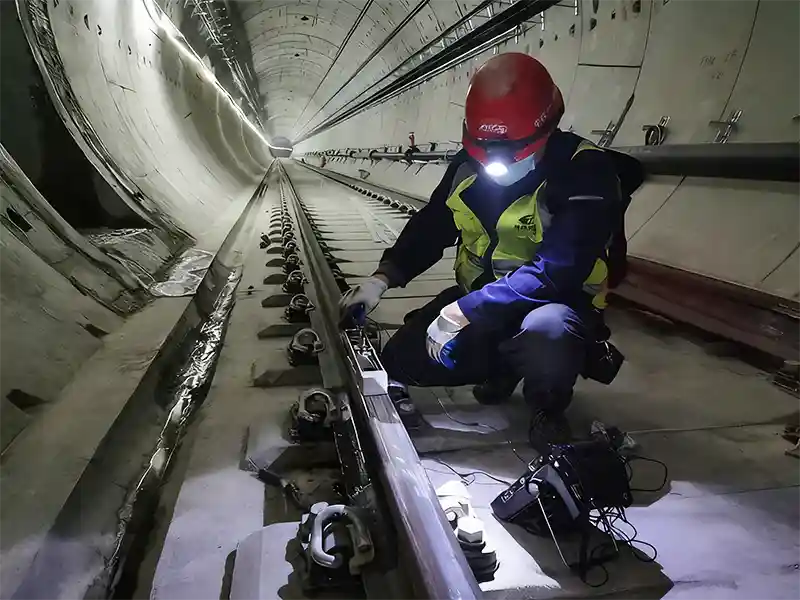
Rail Ultrasonic Testing plays a critical role in ensuring the long-term safety, durability, and reliability of modern railway infrastructure. As a professional rail manufacturer and global supplier, we understand that superior steel rails are not only the result of advanced smelting and rolling processes, but also of world-class nondestructive testing technology. To guarantee defect-free and high-reliability products, we perform full-section, digital ultrasonic inspections on every meter of rail in strict accordance with GB/T 12459‑2017.
1. Standard-Driven Quality you Can Trust
Our ultrasonic inspection system is fully compliant with the requirements and methods defined in GB/T 12459-2017, the authoritative Chinese national standard for ultrasonic testing of both new and in-service rails. This standard sets detailed rules for personnel qualifications, equipment performance, sensitivity calibration, scanning techniques, and acceptance criteria. By adhering to such a rigorous technical framework, our quality control meets the expectations of some of the world’s most demanding railway projects, including heavy-haul lines, high-speed networks, and tunnel construction logistics lines.
2. How Rail Ultrasonic Testing Works
We employ multi-probe and multi-angle scanning techniques to achieve seamless coverage of the entire rail cross-section.
Ultrasonic Testing Principle
Our inspection is based on the pulse-echo ultrasonic method. The probe emits high-frequency ultrasonic waves into the rail. When these waves encounter internal discontinuities—such as inclusions, cracks, or pores—they reflect back to the probe. By analyzing the amplitude, travel time, and waveform of the reflected signals, our system identifies the location, size, and nature of any potential defects.
Advanced Digital System
The testing system uses a modern multi-channel digital ultrasonic platform—equivalent to the capabilities of the KZB-1 flaw detector and other internationally recognized devices. This ensures high signal stability, strong anti-interference performance, and accurate defect characterization.
3. Key Detection Zones and Typical Defects
To guarantee structural integrity, different zones of the rail require targeted ultrasonic evaluation:
- Rail head: detection of transverse cracks, longitudinal cracks, oblique cracks, and surface-connected fatigue defects.
- Rail web: detection of horizontal or vertical cracks, internal inclusions, gas pockets, and delamination.
- Rail base: detection of transverse cracks and longitudinal fatigue cracks that may grow under repeated wheel loads.
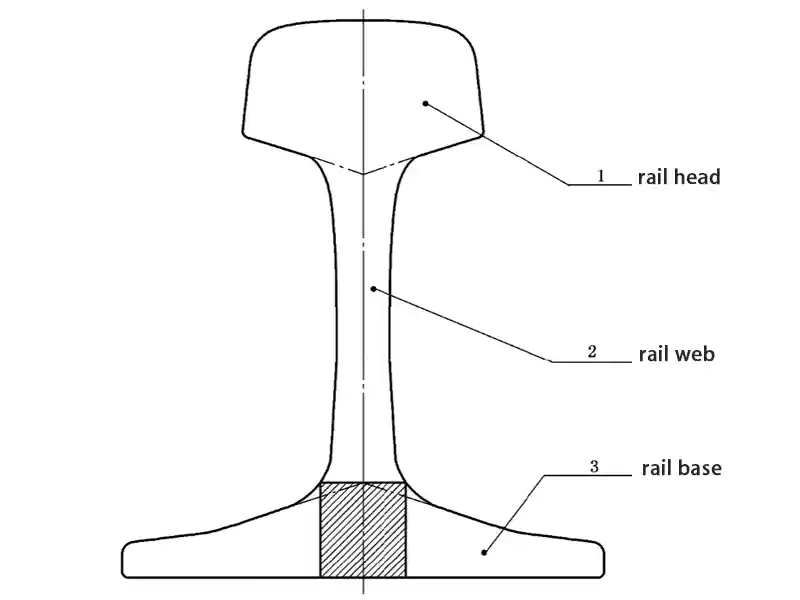
Since these defects directly correlate with acceptance levels defined in GB/T 12459-2017, precise detection is essential to ensure long-term performance and operational safety.
4. Comprehensive Probe Configurations
Full coverage is achieved through a set of specialized probes:
- 0° straight-beam probes: ideal for detecting horizontal defects and internal separations across the rail head, web, and base.
- Angle-beam probes (37°, 45°, 70°): selected according to rail profile and scanning requirements to identify cracks in multiple orientations.
By combining these probes into multi-angle scanning paths, we eliminate blind zones and ensure that every critical area is fully inspected.
5. Strict Quality Control and Defect Evaluation
Our ultrasonic testing is not simply “scan and record”—it is a highly controlled and traceable decision-making process.
Calibration with Standard Blocks
Before daily testing, equipment sensitivity, linearity, and resolution are calibrated using GTS-60 or GTS-80 reference blocks, ensuring stable and accurate detection.
Qualified UT Personnel
All operators hold certified nondestructive testing credentials, backed by extensive theoretical knowledge and hands-on experience.
Defect Quantification & Decision
When a defect indication is found, engineers evaluate it using:
- Reference sensitivity based on Φ3 or Φ4 flat-bottom hole equivalents
- Defect echo amplitude comparison and dB offset calculations
- Acceptance grading (Level A, B, etc.) per standard requirements
The final assessment determines whether the rail is “Accepted,” “Repairable,” or “Rejected.”
6. Added Value Beyond Compliance
While compliance with GB/T 12459-2017 is essential, we go further:
- Full digital traceability: All A-scan waveforms, defect coordinates, and sizing data are archived for future reference and quality verification.
- Custom testing solutions: We can tailor UT procedures to international specifications such as EN standards or project-specific requirements.
- Global market experience: Our rails are exported to Asia, Africa, Europe, and other regions, consistently receiving positive feedback for reliability and performance.
Conclusion
Choosing our rails means choosing more than high-quality materials—it means choosing a commitment to safety, consistency, and engineering excellence. Supported by the strict technical requirements of GB/T 12459-2017 and executed through advanced digital ultrasonic inspection, our Rail Ultrasonic Testing system provides the strongest assurance for your railway project.
For detailed specifications, test reports, or technical documents, feel free to contact us anytime.