
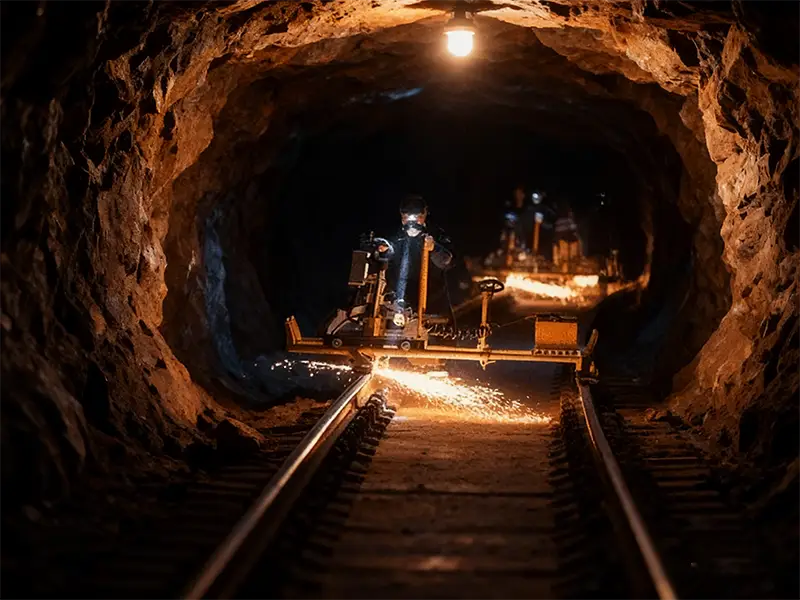
Track laying is a critical part of underground mining transportation systems. High-quality rail installation ensures safe haulage, reduces derailments, and extends the service life of locomotives and wagons. Because mine environments are narrow, humid, and constantly exposed to vibration and impact, the standards for track laying are stricter than those of surface railways. This guide explains the key technical requirements, installation procedures, and safety practices for track laying in coal mines and metal mines.
1. Quality Standards for Mine Track Laying
1.1 Rail Fasteners and Joint Requirements
All fasteners must match the rail type and be fully tightened.
• Joint gap ≤ 5 mm
• Height difference ≤ 2 mm
• Lateral misalignment ≤ 2 mm
For curved tracks, additional gauge rods are required to maintain stability.
1.2 Track Gauge Accuracy
Accurate gauge is the foundation of smooth vehicle operation.
• Straight track gauge deviation: +5 mm / –2 mm
• Curved track gauge deviation: follow design requirements after super-elevation
The inner and outer rail height difference on curves should not exceed 5 mm.
1.3 Sleepers and Ballast
Sleepers must meet the specified type and density:
• Spacing deviation ≤ 50 mm
• Ballast thickness uniform and tamped firmly
• No foreign objects, coal dust, or accumulated water in the track bed
Regular cleaning and tamping are needed to ensure long-term stability.
1.4 Rail Type Consistency
A single track section must use uniform rail type and grade. Turnout rails must not be lower in grade than main track rails.
2. Temporary Track Standards in Mines
According to the standards issued by national mining authorities, temporary mine tracks must meet:
• Gauge error: 5–10 mm
• Joint gap ≤ 10 mm
• Height difference ≤ 5 mm
• Horizontal deviation ≤ 10 mm
• Sleeper spacing ≤ 1 meter
• All fasteners complete and tight
Though temporary, these tracks must still meet load and safety requirements, as they are heavily used during excavation and material transport.
3. Preparation Before Track Laying
Before installation, several checks and preparations are required:
3.1 Surveying and Alignment
Verify tunnel centerline, turnout positions, elevation marks, and curve design. The tunnel must be wide enough for required curve radius.
3.2 Material Preparation
Prepare all rails, sleepers, fasteners, ballast, and tools in advance.
For turnouts, the assembly and adjustment must be completed on the surface, then transported underground as a finished unit.
3.3 Bed Preparation
Remove loose rocks from the roadway bottom, level the surface according to design slope, and pre-lay ballast if required.
4. Track Laying Procedures
4.1 Ballast and Sleeper Placement
• Lay bottom ballast layer (usually 100 mm)
• Position sleepers according to the centerline
• Ensure consistent spacing with appropriate tools
• For concrete sleepers, use clamps or clips to secure the rails
4.2 Rail Placement and Alignment
Rails are carried by teams of workers using hooks.
• Maintain correct joint gap
• Straight sections: joints aligned
• Curves: joints staggered by 1/3 to 1/4 of rail length
• Joint area must remain suspended; sleeper should not be placed directly underneath
4.3 Fastening and Tamping
Track fastening differs depending on sleeper type:
Wood sleepers:
• 4 spikes per sleeper in straight sections
• 6 spikes per sleeper in curves
Concrete sleepers:
• Use clamping systems; ensure clips are tight
After fastening, ballast must be tamped firmly under and around sleepers to eliminate voids and improve stability.
4.4 Geometry Correction
Inspect and correct:
• Gauge accuracy
• Rail levelness
• Joint straightness
• Superelevation on curves
• Track centerline and elevation markers
After adjustments, fill remaining ballast and compact it to ½–⅔ sleeper height.
4.5 Trial Operation
Before opening to traffic, conduct a trial run to check for vibration, noise, or rail deformation. Any abnormality must be corrected immediately.
5. Track Laying on Inclined Roadways
Inclined tracks require additional safety and structural measures:
• Install long sleepers every track length to connect both rails
• Each sleeper end must use three spikes (triangular pattern)
• Anti-slip steel rods must be installed every 10 meters
• Rails and materials must be tied to prevent sliding
• Blocking devices must be installed at both upper and lower ends during construction
When slope exceeds 25 degrees, simultaneous work on both sides is prohibited for safety reasons.
6. Turnout Installation in Mines
Turnouts must be assembled and tested on the surface, then transported underground.
Installation steps include:
• Marking centerlines and turnout starting points
• Laying switches, frogs, straight rails, curved rails, and guard rails according to design
• Installing connecting rods, check rails, and operating mechanisms
• Conducting isolated turnout traffic test before full track connection
Conclusion
Track laying in underground mines is a highly technical and safety-critical process. From surveying and preparation to fastening, tamping, and final inspection, every step must meet strict engineering standards. Properly installed tracks reduce derailments, improve haulage efficiency, and ensure long-term operational safety in challenging underground environments. By following standardized procedures and maintaining consistent quality control, mining operations can achieve safer and more reliable transport systems.