
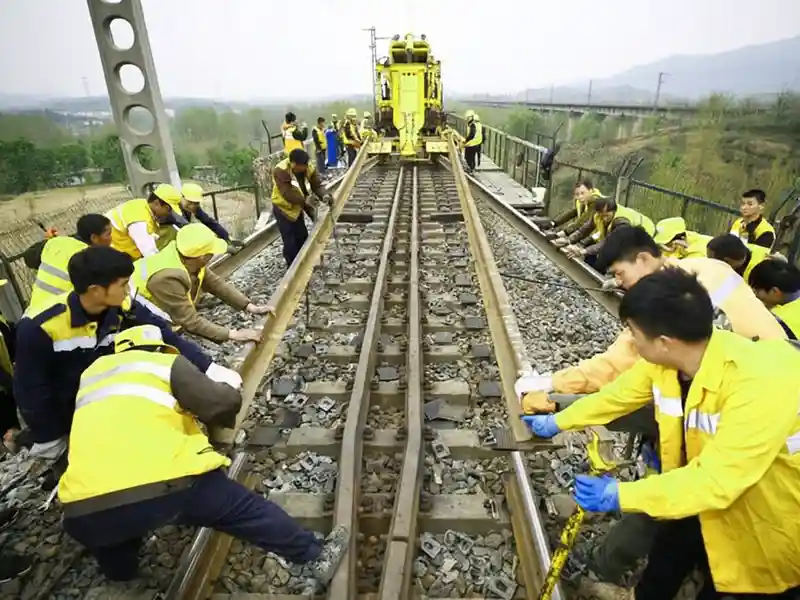
One of the biggest advances in railway engineering is the switch from conventional jointed tracks to Continuous Welded Rail (CWR). CWR reduces the dynamic impact between wheels and rails by removing the spaces between rail sections, which improves ride quality, increases speed potential, and dramatically lowers maintenance costs.
The professional engineering procedure and technical benchmarks for installing continuous welded rail are described in the following guide
1. Production of Long Rail Units (LRUs)
The creation of a seamless track begins in a controlled factory environment, often referred to as a Rail Welding Depot. Standard steel rails (typically 100 meters long) are joined into “Long Rail Units,” which are usually 500 meters in length, though this varies based on transport logistics.
The Flash-Butt Welding Process
Fixed-station flash-butt welding is the gold standard here. This process uses high-voltage electrical resistance to heat the rail ends to a plastic state before forging them together under immense hydraulic pressure.
- Quality Control: Unlike manual welds, factory welds are highly automated. Each joint undergoes ultrasonic flaw detection and “drop tests” to ensure the weld’s structural integrity is at least 90% of the parent metal’s strength.
2. Transportation and Offloading
Once the 500-meter strings are ready, they are loaded onto specialized long-rail train sets. These trains consist of dozens of flatcars equipped with rollers, locking mechanisms, and anti-toppling devices.
At the construction site, the rail is pulled from the train using a power unit (such as a locomotive or specialized pusher) and guided directly into the tie seats (rail seats). It is crucial to control the curvature during offloading to prevent “hard bends” or permanent twisting of the steel.
3. Field Welding and Assembly
Once the long units are positioned on the sleepers, they must be joined to create a truly continuous ribbon of steel. Two primary methods are used in the field:
Mobile Flash-Butt Welding
A specialized truck or hi-rail vehicle carries a miniaturized version of the factory welder. It moves along the track, clamping the rail ends and welding them with the same high-pressure logic used in the depot. This is the preferred method for high-speed lines due to its consistency.
Thermite (Aluminothermic) Welding
In areas where heavy machinery cannot reach—such as turnouts, bridges, or final closure joints—thermite welding is used.
- The Reaction: A mixture of aluminum powder and iron oxide is ignited in a crucible, creating molten steel at temperatures exceeding 2,400°C. This molten metal is poured into a mold around the rail gap.
- Post-Processing: Once cooled, the excess metal is sheared off, and the joint is precision-ground to match the rail profile.
4. Stress Relief and Rail Anchoring
Steel expands and contracts with temperature. In CWR, the rail is restricted from moving, which creates massive internal longitudinal stresses. To prevent the track from buckling in summer (sun kinks) or snapping in winter, the rail must be “locked” at a specific temperature.
Neutral Temperature (NT) / Rail Tightness
The Neutral Temperature is the rail temperature at which the steel is under zero thermal stress. Engineers calculate a Design Locking Temperature based on the local climate’s extreme highs and lows.
Stress Dispersion Methods
If the ambient temperature isn’t ideal during installation, engineers use two main techniques:
- Mechanical Stretching: If the rail is too cold (and thus too short), hydraulic rail tensors pull the steel to the physical length it would be at the neutral temperature.
- Thermal Expansion: Using heaters or “rail ovens” to expand the rail to the required length before fastening it down.
Once the target length is achieved, the fasteners (clips) are tightened, “locking” the stress into the rail.
5. Geometric Fine-Tuning and Finishing
After the rail is locked, the track undergoes a “polishing” phase to ensure it meets the sub-millimeter tolerances required for modern rail travel.
- Tamping and Stabilization: Heavy maintenance machinery (tampers) lifts and shifts the track to its final vertical and horizontal alignment while vibrating the ballast to ensure a solid foundation.
- Profile Grinding: Specialized grinding stones smooth the weld joints and the rail head. The goal is a surface deviation of less than 0.3 mm over a 1-meter span, eliminating the “clickety-clack” noise and vibration.
Summary
Continuous Welded Rail is not just about joining rails together. It requires proper control during installation, especially in terms of stress, alignment, and temperature. When these factors are handled correctly, the track becomes more stable, reduces maintenance needs, and performs better under heavy traffic and high-speed conditions.