
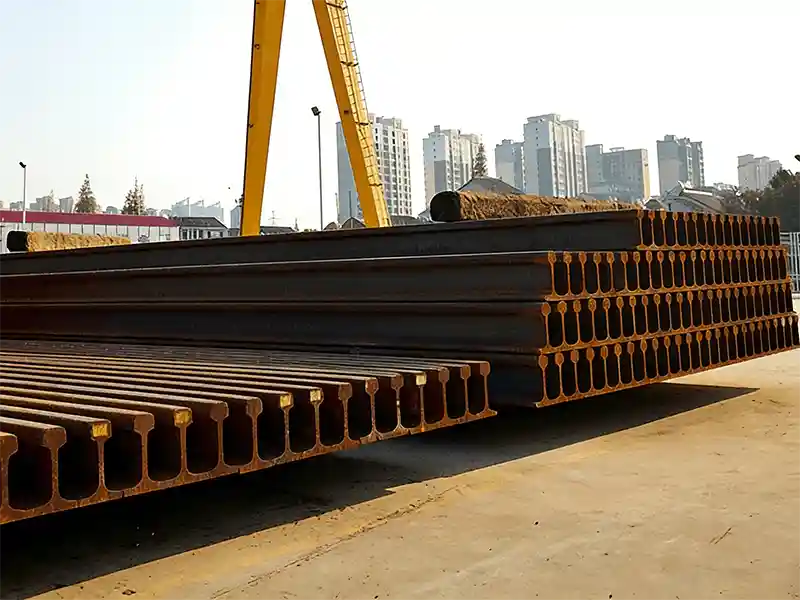
Steel rails are the backbone of any railway infrastructure. Their storage quality directly impacts the safety and long-term stability of the track laying process. Scientific and standardized rail stacking and storage not only protect the rails from physical damage and corrosion but also serve as a critical preventative measure against site accidents.
Drawing from international technical standards and on-site management experience, this guide outlines the essential requirements for professional rail storage.
1. Site Foundation and Ground Conditions
The foundation is the most critical element of a safe storage area. For long-term facilities, we recommend a concrete beam foundation designed to meet specific load-bearing requirements. If a rail-track base is used, the ground beneath must be thoroughly compacted.
A professional storage yard must be level, well-ventilated, and equipped with an efficient drainage system to prevent water accumulation. For outdoor storage, the bottom layer must be elevated:
- Concrete floors: Elevated by at least 0.1 meters.
- Soil/Dirt ground: Elevated by 0.2 to 0.5 meters to protect against moisture and rust.
Additionally, storage sites should be located away from industrial plants that emit corrosive gases or dust.
2. Classification and Inventory Labeling
To prevent confusion and potential cross-corrosion, rails must be sorted by grade, model, manufacturer, and technical standards. Mixing different specifications is strictly prohibited.
Each stack should be clearly labeled with a weatherproof sign indicating the origin, rail type, specifications, and total quantity. For example, 50kg/m and 60kg/m rails must be kept in separate zones. This level of organization ensures full traceability—from receipt to dispatch—and keeps warehouse records 100% accurate.
3. Stacking Methods and Dunnage Placement
Rails should be stacked in an upright (head-up) position, ensuring they are straight, stable, and neatly aligned. The maximum allowable offset between rail ends at one side should not exceed 200mm.
Dunnage (Support Materials): Hardwood timber or steel plates should be used as spacers between layers, placed perpendicular to the rails.
- Spacing: 5 meters to 7.5 meters apart.
- Alignment: Critical! The spacers in the upper and lower layers must be vertically aligned, with a deviation of no more than 50mm. This prevents localized stress concentrations that could warp the rails.
4. Stacking Height and Layer Limits
The number of layers is strictly limited based on the rail length and the duration of storage:
- Standard 100m Rails: Maximum 15 layers.
- Long Welded Rails (LWR): Generally limited to 6 layers.
- Temporary Construction Sites: Maximum 10 layers (reduced to 8 layers if stored for more than 6 months).
Unprotected rails (without anti-rust treatment) should not remain in the bottom layer for more than six months. Regular inspections are necessary to check for signs of rust, pressure damage, or deformation.
5. On-Site Safety and Protection
When temporarily stacking rails along an active line, safety clearances are non-negotiable. Goods must be placed at least 1.5 meters from the outer edge of the rail head. On station platforms, a 1-meter safety margin from the platform edge is required.
During lifting operations, “slow start, soft landing” is the rule. Always keep the rail as level as possible to avoid permanent bending. Lifting should be suspended during extreme weather, such as heavy rain or high winds.
6. Best Practices for Warehouse Management
Safety is a continuous process. Implementing a routine inspection mechanism—including cross-checks of physical stock against digital ledgers—is vital. Before monsoon or typhoon seasons, specialized audits should ensure that drainage is clear and stack stability is reinforced.
Conclusion
Effective rail stacking and storage is a systematic undertaking. By strictly following these technical specifications, companies can ensure the integrity of their materials and the safety of their personnel.
At Glory Rail, we understand that high-quality storage is just as important as high-quality manufacturing. We maintain an extensive inventory of various rail standards (including GB, UIC, AS, and JIS) in our professionally managed yards. Whether you need heavy-duty crane rails or standard railroad tracks, Glory Rail provides ready-to-ship stock that has been stored under the strictest safety and technical protocols.