
Whether flat bar can be used as a crane rail cannot be determined solely by the steel’s width, thickness, or the equipment’s rated lifting capacity. Flat bar crane rail can be used for certain light-duty trolleys, equipment guidance, and simple transfer lines, provided that the flat bar’s cross-section, wheel contact method, support structure, and mounting solution are suitable for the actual operating conditions. If the equipment must withstand significant wheel loads, operate frequently, or has high requirements for rail wear resistance and operational stability, the flat bar solution should be compared with dedicated crane rails—rather than assuming the two are interchangeable by default.
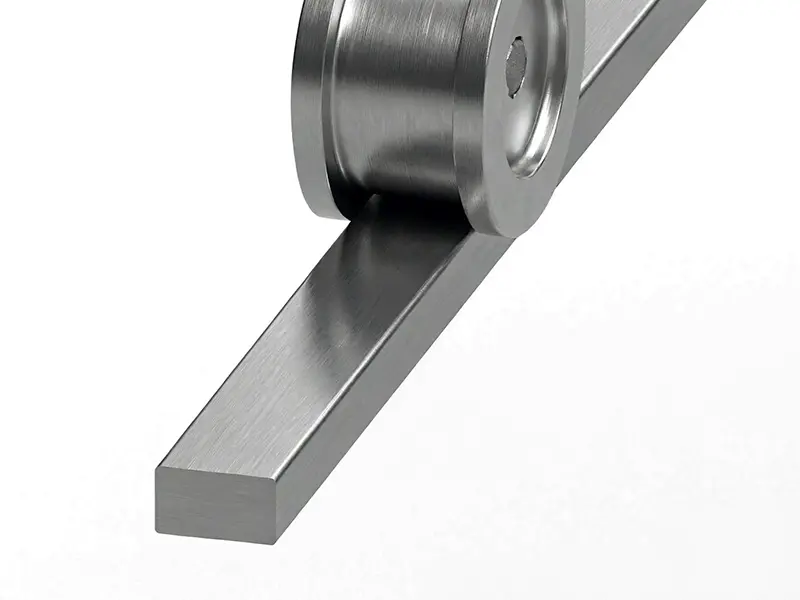
1.Under what circumstances can flat bar be considered for use as a rail?
The advantages of flat bar lie in its simple cross-section; certain specifications are readily available, and it may be easy to cut and process. However, whether it is suitable for use as a rail depends on the equipment’s operating mode, not merely on the application’s name.
Light-Load Trolleys and Simple Transfer Equipment
For some trolleys with relatively light loads and low operating speeds, flat steel can be considered as a candidate rail material. During design, it is still necessary to confirm whether the wheels can run stably on the flat steel and whether the steel will experience excessive bending or deformation under the support spacing and actual load.
Equipment Guide Rails
Some equipment needs to move along a fixed path, where the rail’s function may extend beyond load-bearing to include restricting the direction of movement. In such cases, the structure of the wheels or guide wheels must be verified first. If the equipment relies on flanges, V-grooves, or other specialized profiles for guidance, the edge shape and contact points of the flat steel cannot be overlooked.
Temporary or Simple Transfer Lines
In some temporary transfer scenarios, flat steel may offer convenience in terms of fabrication and installation. However, temporary lines still require reliable support and securing. If the line is long, has numerous joints, or if equipment repeatedly passes through the same location, joint flatness, track alignment, and local deformation can all affect operation.
Here is a distinction that is easily overlooked: just because the equipment load is light does not mean that the contact conditions between the wheels and the track are necessarily suitable. Even if the entire piece of equipment is not heavy, localized wear or deformation may occur if the load is concentrated in a small contact area or if the flat steel lacks sufficient support.
2. What are the practical differences between flat steel and standard crane rails?
Flat bar is steel with a rectangular cross-section, whereas QU-series and DIN A-series crane rails are specialized profiles designed for specific track applications. The difference goes beyond mere shape; it also involves how the wheels contact the rails and how the rails bear and transmit loads.
| Comparison | Flat Steel Bar | Standard Crane Rail |
|---|---|---|
| Cross-Section | Rectangular cross-section with flexible dimensional options | Purpose-designed rail profile |
| Wheel Contact | Depends on bar dimensions, edge geometry, and wheel design | Must match the rail profile and wheel configuration |
| Load Capacity and Support | Requires assessment of the actual loads, support spacing, and cross-section | Also requires verification of loads and installation conditions; the rail designation alone is not sufficient |
| Installation | Fixing arrangements may need to be designed for the specific application | Depends on the rail profile, supporting structure, and fastening method |
| Procurement and Processing | Some sizes can be readily cut or processed to suit project requirements | Selected and supplied according to the required rail profile and project specifications |
If a project uses specialized crane rails, one should not assume that a flat steel can replace the original rail simply because its width and thickness appear similar.
For example, profiles such as QU70, QU80, QU100, QU120, as well as DIN A45, A55, A65, and A75, each have their own cross-sectional dimensions. When selecting, it is necessary to verify the specific profile, wheel configuration, and track structure, rather than simply comparing unit weight or external dimensions.
For projects with high wheel loads, high operating frequencies, or where track wear and alignment accuracy directly affect equipment operation, it is generally more reasonable to prioritize specialized rail solutions. Whether flat steel is suitable should be determined by actual design conditions, not by material cost.
3. What details are often overlooked when using flat steel as track?
Before finalizing a flat steel solution, several specific issues should be clarified first.
Wheel Loads and Support Spacing
One cannot rely solely on the equipment’s total weight. It is also necessary to consider the equipment’s dead weight, maximum wheel load, number of wheels, and load distribution, as well as the structure supporting the flat steel and the spacing between supports. These conditions affect the bending and deflection of the flat steel. Whether the cross-sectional dimensions are sufficient should be verified based on actual operating conditions.
Wheel-to-Flat Bar Contact Method
Flat wheels, flanged wheels, and V-groove wheels all make contact with the flat bar in different ways. It is necessary to confirm the actual contact points of the wheels, the available running width, and whether the wheels will experience edge interference. The suitability of the contact area cannot be determined solely based on the width of the flat bar.
Corner Radius (R)
The radius of the curved edges along the length of the flat bar may affect the wheel’s contact point. If a project requires a specific R value, this should be specified during procurement or fabrication.
For example, “R3” indicates a nominal radius of 3 mm; however, this is merely an illustrative example and not a uniform requirement for all flat bar tracks. The actual radius should be determined based on the wheel profile, contact point, and design requirements. If only the width and thickness of the flat steel are specified at the time of procurement without confirming the edge radius, the received material may not meet the expected wheel contact conditions.
Fastening, Welding, and Joint Treatment
Flat steel can be secured using appropriate clamping methods or welding, depending on the structure; however, both methods must be integrated with the support structure design. Welding may cause deformation, so the welding sequence and post-installation straightness must be considered.
If the track consists of multiple sections of steel joined together, it is also necessary to check that the joints are level to prevent height differences or protruding welds from interfering with wheel passage. For longer tracks, the need for expansion gaps should be determined based on track length, temperature variations, and fastening methods; a fixed spacing cannot simply be applied across the board.
These issues do not mean that flat steel cannot be used for tracks; rather, they illustrate that: A flat steel solution must be designed in conjunction with the wheels, supports, and installation structure; one cannot simply purchase the steel and then decide how to install it.
4. How should one choose between hot-rolled and cold-drawn flat steel?
Only after confirming that the flat steel’s cross-section and intended use meet requirements is it necessary to further compare hot-rolled and cold-drawn products. The differences between the two extend beyond price and also involve dimensional tolerances, surface condition, processing requirements, and actual procurement conditions.
Hot-Rolled Flat Steel: First, Confirm Whether Tolerances Meet Requirements
Hot-rolled flat steel is typically a viable candidate for cost-sensitive projects, but it is essential to verify that the actual supplied dimensions and their tolerances meet design requirements.
Hot-rolled surfaces may have iron oxide scale. If the rail contact surfaces require further machining or the edges and corners need finishing, these subsequent processing costs must be factored into the overall cost. One should not merely compare the unit price of raw materials while ignoring the actual cost after processing.
Purchase volume also influences the selection. Some specifications may be subject to a minimum order quantity (MOQ) set by the steel mill, and small-batch orders may not be directly procured in the desired quantities. The specific MOQ should be based on the actual requirements of the steel mill and supplier for the corresponding specifications; a common order quantity should not be treated as a universal rule for all specifications.
Cold-Drawn Flat Steel: Compare Only When High Precision Is Required
Cold-drawn or other cold-worked, precision-finished products can be used for projects with high requirements for dimensional accuracy and surface finish. However, actual tolerances and surface quality must still be determined by the product’s specifications and terms of supply; one cannot assume that a product meets rail requirements simply because it is labeled “cold-drawn.”
Cold working may also alter the material’s mechanical properties; therefore, the actual material grade and delivery condition must be verified. If the project also requires special lengths, rounded corners, or other custom processing, the additional processing costs must likewise be factored into the comparison.
What Should You Really Compare When Purchasing?
Suppose a project requires a small quantity of flat bar. First, confirm whether hot-rolled products can meet the dimensional and corner requirements. If so, there is no need to incur additional costs simply because cold-drawn products have a better surface finish.
Conversely, if the tolerances of hot-rolled products cannot meet design requirements, and subsequent processing would increase costs or introduce new dimensional control issues, it is worth comparing cold-drawn products with other viable processing options.
Therefore, the material selection for flat bar crane rails cannot be simply reduced to “hot-rolled is cheaper, cold-drawn is more precise.” What truly needs to be compared are the material costs, processing costs, purchase quantities, and supply terms of both options after they have met the same set of design requirements.
Conclusion
Flat bar can be used in certain properly designed, light-load rail applications, but it is not a universal substitute for standard crane rails. Before finalizing a solution, one should first verify the wheel loads, contact methods, support structures, edge and corner requirements, and installation conditions, and then determine the material specifications and processing methods.
For projects currently evaluating flat steel rail solutions, Glory Rail can discuss relevant steel grades and rail selection based on specific requirements. Actual supply specifications, processing capabilities, and procurement terms must still be confirmed according to project requirements, particularly for orders with specific requirements regarding dimensional tolerances, R-corners, and custom processing.