
Introduction
If adhesion between the wheel and rail drops, you notice it right away. The train struggles to accelerate, braking becomes less predictable, and in bad cases, wheels start slipping. This isn’t a rare situation either. In everyday railway operation, especially in wet or contaminated conditions, wheel-rail adhesion is constantly changing. That’s exactly why sanding systems are still widely used — not because they are advanced, but because they work.
What Really Causes Wheel Slip?
In theory, wheel slip happens when traction demand exceeds available friction. But in practice, the reason is usually much simpler: the rail surface isn’t clean or dry.
You’ll often see adhesion problems when:
- The rail is wet after rain
- There’s a thin film from crushed leaves
- Oil or industrial dust builds up on the surface
- Frost or light ice forms in cold weather
None of these need to be thick layers. Even a very thin film can reduce friction more than expected.
Add heavy loads or a gradient into the mix, and the system reaches its limit quickly.
Once slipping starts, it tends to get worse. Heat builds up locally, surfaces begin to polish, and in some cases, wheel flats can form. That’s when maintenance teams start getting involved.
So What Does Sanding Actually Do?
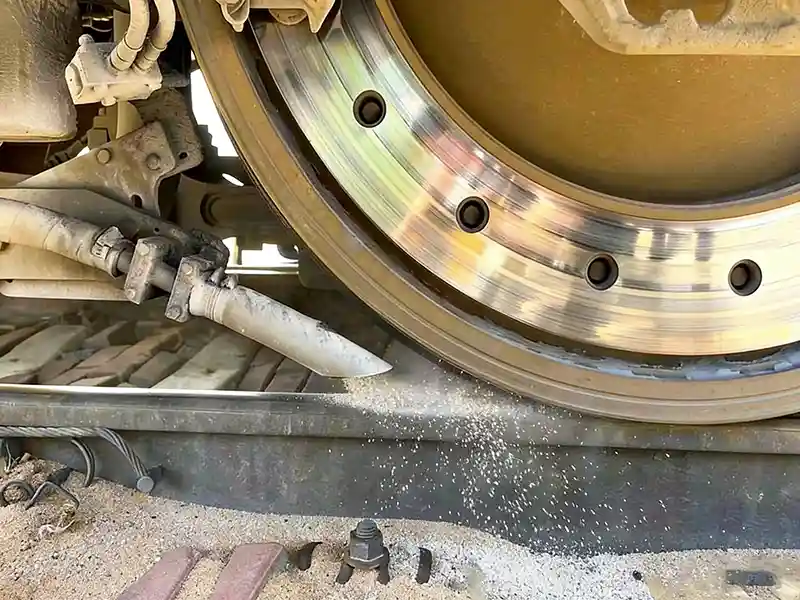
Sanding looks simple — just drop sand in front of the wheel — but the effect is quite interesting.
When sand particles enter the contact zone, they don’t stay intact for long. Under high pressure, they break into smaller, sharp fragments. These fragments increase friction in a very direct, mechanical way.
From field data and operational experience, adhesion can jump from something like 0.05 on a wet rail to around 0.3 after sanding. That’s a big difference in terms of usable traction.
But it’s not only about friction.
Sand also helps:
- Break up water or oil films
- Push contaminants out of the contact patch
- Create a more stable interface for force transmission
So it’s doing both cleaning and friction enhancement at the same time.
Timing Matters More Than You Think
One thing operators learn quickly is that sanding works best before things get out of control.
If you wait until the wheel is already slipping badly, the benefit is limited. That’s why modern trains don’t rely only on manual control anymore.
Systems like WSP (Wheel Slide Protection) or ASR continuously monitor wheel behavior. When they detect the early signs of slip, they trigger sanding automatically — often together with a slight reduction in traction force.
This combination is much more effective than sanding alone.
Is More Sand Always Better?
Not really.
Too little sand obviously won’t help much. But too much sand creates its own problems:
- Material waste
- Contamination of ballast
- Possible interference with track circuits in extreme cases
So in real operation, the goal is controlled delivery — usually within a defined flow range and using properly graded sand.
Conclusion
Sanding systems are not new technology, but they remain one of the most practical solutions for improving wheel-rail adhesion. They don’t eliminate the root cause of low adhesion, but they give operators a reliable way to deal with it in real time. And in situations like wet weather, steep gradients, or frequent stop-start operation, that reliability makes a big difference.
In demanding conditions, reliable adhesion control is not optional — it’s essential for safe railway operation. Solutions such as well-designed rail systems and components from brands like Glory Rail are often used to support stable performance in these environments.