
What Is Crane Rail Force Analysis and Why Does It Matter?
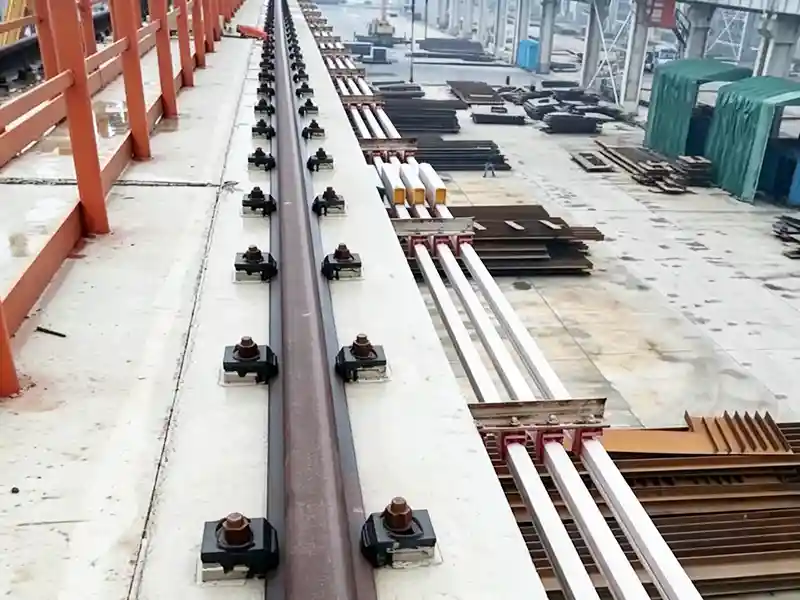
In overhead crane systems, rail failure is rarely caused by the rail itself. In many real-world cases, the root cause lies in inadequate rail fixing systems, particularly the failure of rail clamps or clips. Although standards such as 05G525 and 04G325 provide general guidance, they are increasingly insufficient for modern high-capacity cranes. As crane loads and speeds increase, traditional fixing methods often fail to accommodate complex and dynamic force conditions. This is why crane rail force analysis is essential. Understanding how forces act on the rail system provides a reliable basis for selecting and designing more effective rail clamps.
How Are Forces Transmitted in a Crane Rail System?
An overhead crane transfers load through a clear mechanical path:
- Lifting device (hook, grab, or magnet)
- Bridge structure
- Crane wheels
- Rails
- Rail fixing system (clips / clamps)
- Supporting beam and foundation
From an engineering perspective, forces acting on crane rails can be divided into three directions:
- Vertical forces
- Longitudinal forces
- Lateral forces
Under static conditions, loads are relatively predictable. However, in real operations, dynamic effects such as acceleration, impact, uneven rails, and structural deformation significantly complicate the force distribution.
1. Vertical Force: The Dominant Load on Crane Rails
Vertical force is primarily generated by:
- Crane structure weight (U)
- Trolley weight (G₀)
- Rated lifting capacity (Q)
In simplified engineering estimation:
- The maximum wheel load represents the peak vertical force applied to the rail
- This force is balanced by the supporting beam beneath the rail
In ideal conditions, vertical force does not significantly challenge the rail clamp. However, in practice:
- Beam deflection
- Uneven installation
- Differential settlement
can lead to uneven load distribution, indirectly increasing stress on rail clamps.
2. Longitudinal Force: The Key Factor in Rail Clamp Failure
Unlike vertical force, longitudinal force is often the critical factor affecting rail fixing systems.
The total longitudinal force acting on the rail can be expressed as:
- Rolling resistance
- Wind load
- Acceleration force
- Gradient-induced force
Together:
FY = FR + FW + FA + FG
Key components:
(1) Rolling Resistance
Generated at the wheel–rail interface:
- Typically 2%–4% of total load
- Directly proportional to crane weight
(2) Wind Load
Especially critical for outdoor cranes (ports, yards):
- Depends on exposed area and wind speed
- According to GB standards, design wind speed is typically ≤16 m/s
(3) Acceleration Force
Occurs during starting and braking:
- Proportional to crane mass and travel speed
- Often underestimated in design
(4) Gradient Force
Caused by uneven rail elevation:
- Even small angular deviations generate additional force
- A major hidden factor in rail system instability
Why It Matters
Longitudinal forces act directly against rail clamps.
If the clamp cannot provide sufficient resistance:
- Rail slippage occurs
- Fasteners loosen over time
- System alignment deteriorates
This is why high-strength, forward-locking rail clamps are essential in modern crane systems.
3. Lateral Force: The Main Cause of “Crane Skewing”
Lateral forces arise from:
- Trolley movement
- Misalignment between rails
- Uneven beam elevation
- Wind from side direction
The total lateral force can be summarized as:
Fx = FR + FW + FA + FG
Where contributing factors mirror longitudinal forces but act across the rail.
Practical consequences:
- Rail side movement
- Wheel flange wear
- “Crane skewing” or binding
Why Traditional Rail Clips Often Fail
Common issues with conventional rail fixing systems include:
- Lack of anti-slip design
- No self-locking mechanism
- Insufficient clamping force
- Poor resistance to dynamic loads
For example:
- Double-bolt plates (GDGL type)
- Standard clips from older design codes
These designs can slide laterally or loosen over time, especially under combined longitudinal and lateral forces.
What Kind of Rail Clamp Works Better?
Based on crane rail force analysis, an effective rail fixing system should have:
- Adjustability (to accommodate installation tolerances)
- Anti-loosening design
- Self-locking capability
- Strong resistance to longitudinal forces
- Welded or reinforced fixing structure
In practical applications, systems such as RTYB and WJK-type rail clamps are designed to:
- Resist multi-directional forces
- Maintain rail alignment
- Prevent rail creep and skewing
Conclusion
Crane rail systems are constantly subjected to a combination of vertical, longitudinal, and lateral forces, all of which vary with load conditions, operating speed, structural alignment, and environmental factors. In practice, it is not the vertical load but the often-overlooked longitudinal and lateral forces that lead to rail movement, clamp loosening, and long-term system instability. This makes crane rail force analysis not just a theoretical exercise, but a critical basis for ensuring safe and reliable operation. In real engineering applications, selecting a well-designed rail fixing system becomes essential to maintaining alignment and preventing failure. Solutions developed by Glory Rail, such as adjustable and self-locking rail clamps, are specifically engineered to address these multi-directional forces, helping improve stability, extend service life, and ensure safer crane operation.