
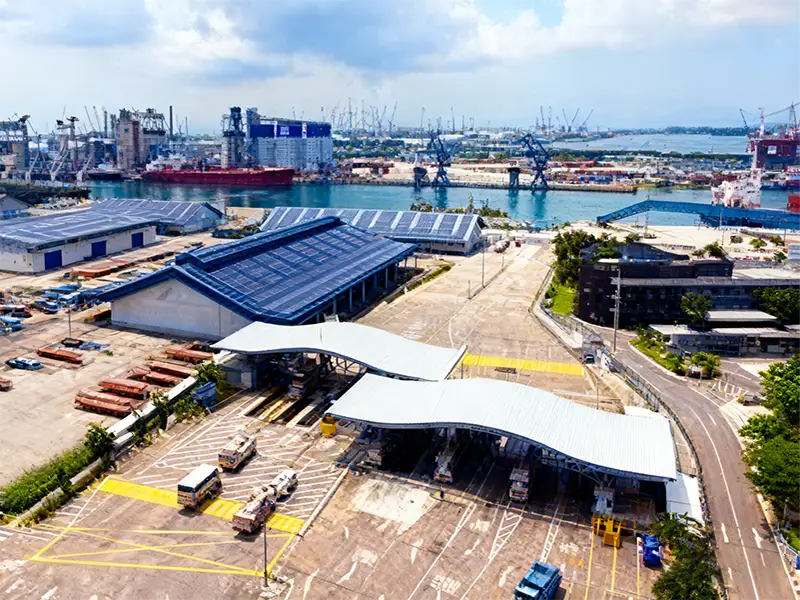
Glory Rail has completed the supply and technical support for the port rail system at the RMC terminal of Jurong Port, Singapore. This project demonstrates Glory Rail’s engineering capability in designing and delivering heavy-duty rail systems for port operations requiring high corrosion resistance and long-term stability.
Project Overview
The RMC terminal at Jurong Port handles large volumes of ready-mix concrete (RMC) and related materials. The operation requires a stable, precise, and corrosion-protected rail system for material transport and equipment movement along the quay. The project scope covered a 4,500-meter rail track built on steel beam structures, using P50 rail profiles and 1615-type rail fastening systems.
The total installation consumed 211 tons of P50 rails and about 20,000 sets of 1615 rail clips, with a total project value exceeding USD 420,000. All rail and fastening components were supplied, inspected, and coated according to the client’s technical specifications.
Design Requirements and Engineering Considerations
The port’s RMC terminal environment is characterized by high humidity, salt air, and chemical exposure from cement and concrete operations. The rail system needed to maintain precise track geometry while resisting corrosion and vibration fatigue.
To achieve this, the system adopted a P50 rail, a standard heavy rail profile known for high tensile strength and bending resistance. Rails were mounted on H-beam steel supports instead of traditional concrete sleepers, which offered better adaptability for the terminal’s structural layout and simplified alignment adjustments.
The 1615-type clip assembly was selected as the fastening solution due to its mechanical reliability and ease of maintenance. Each clip base was welded directly to the H-beam flange, providing a rigid yet adjustable interface that minimizes rail movement and vibration.
Fastening and Structural Details
- Rail Type: P50 (GB standard, U71Mn material)
- Track Length: 4,500 meters
- Fastening System: 1615-type adjustable clip assembly
- Base Support: Welded H-beam steel structure
- Bolts: Grade 8.8 high-strength bolts for maximum clamping force
- Anchoring: Continuous welded bases ensuring positional accuracy
- Accessories: Hot-dip galvanized steel components for corrosion resistance
The rail fastening system was designed to allow minor alignment correction while maintaining a tight grip under dynamic loads. This structure provides the necessary elasticity to absorb wheel impacts and reduce noise and wear during operation.
Corrosion Protection and Surface Treatment
Given Singapore’s marine climate, corrosion control was a critical part of the design. All P50 rails underwent abrasive blasting and industrial-grade anti-corrosion spray coating, achieving uniform film thickness and strong adhesion. Fasteners, clips, and bolts were hot-dip galvanized, ensuring zinc coverage of all surfaces including threads and edges.
The coating system was verified through salt spray tests and thickness inspections according to ISO standards. These procedures ensured that the entire port rail system would maintain integrity over years of exposure to sea air and chemical dust.
Quality Assurance and Third-party Certification
Throughout the entire process of production and delivery, Glory Rail has implemented strict quality assurance procedures for the entire supply chain. Each batch of P50 tracks passes through:
Material verification: Confirm compliance with specified standards through chemical and mechanical tests.
Dimensional inspection: Continuously monitor the straightness of the track, the width of the rail head and the accuracy of the hole position to ensure precise alignment of the track.
Coating quality control: After anti-corrosion treatment, adhesion and thickness measurements are conducted to verify the uniformity of the protective layer.
Fastener testing: Torque and preload verification was carried out on 8.8 grade bolts to ensure stable clamping performance.
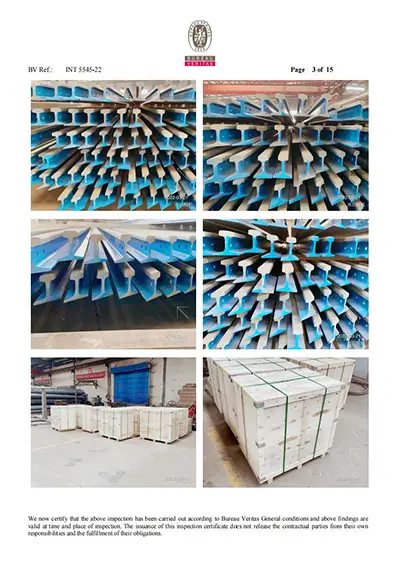
Third-party verification by Bureau Veritas (BV)
To ensure complete transparency and product integrity, all batches of rails and fasteners undergo independent inspection by Bureau Veritas. BV implementation
Sampling inspection of the mechanical strength, surface quality and dimensional tolerance of rails
Coating document review and anti-corrosion standard verification
Fastener assembly test witness, confirming that all bolts comply with Grade 8.8 standard
BV officially issues the inspection report, certifying that all materials meet the project specifications and international standards. This independent verification has strengthened the reliability and compliance of the rail system supplied to Jurong Port.


Performance and Operational Benefits
After installation, the RMC port rail system has provided stable track alignment and low-maintenance operation. The rigid clip-to-beam connection prevents displacement under heavy wheel loads, while the corrosion protection significantly reduces maintenance cycles. Operators have reported smooth and quiet operation with minimal rail wear.
The modular design also allows fast replacement of clips or bolts without disrupting the main track structure—an important feature for port terminals that operate continuously.
Project Value and Significance
The Jurong Port RMC project is a benchmark example of how engineered port rail systems can improve operational reliability and safety in heavy industrial environments. By combining P50 heavy rails, 1615 fastening systems, and advanced surface protection, Glory Rail delivered a rail infrastructure that meets the long-term performance demands of one of Singapore’s busiest industrial ports.
This project reinforces Glory Rail’s position as a trusted global supplier of port, industrial, and logistics rail systems, capable of handling projects that require both structural engineering precision and environmental resilience.
About Glory Rail
Glory Rail provides complete rail system solutions for ports, industrial facilities, and tunneling projects worldwide. Our products include steel rails, fastening systems, baseplates, and welding accessories—all designed for high mechanical performance and long service life. Through strict quality control and technical expertise, we support global clients in building durable and efficient rail infrastructure.