
ASCE Rail
ASCE Rail, a North American standardized steel rail compliant with ASTM A1, is made of high-carbon steel for superior strength, wear, and impact resistance. Designed for heavy-haul needs, its uniform profile ensures global railway compatibility. Widely used in heavy freight lines, industrial spurs, switch zones, port terminals, and mining networks, it withstands frequent axle loads and harsh conditions.
Type: Light-duty Crane Rail Material: 55Q/U71Mn Standard: ASTM/AREMA Certification: ISO CE
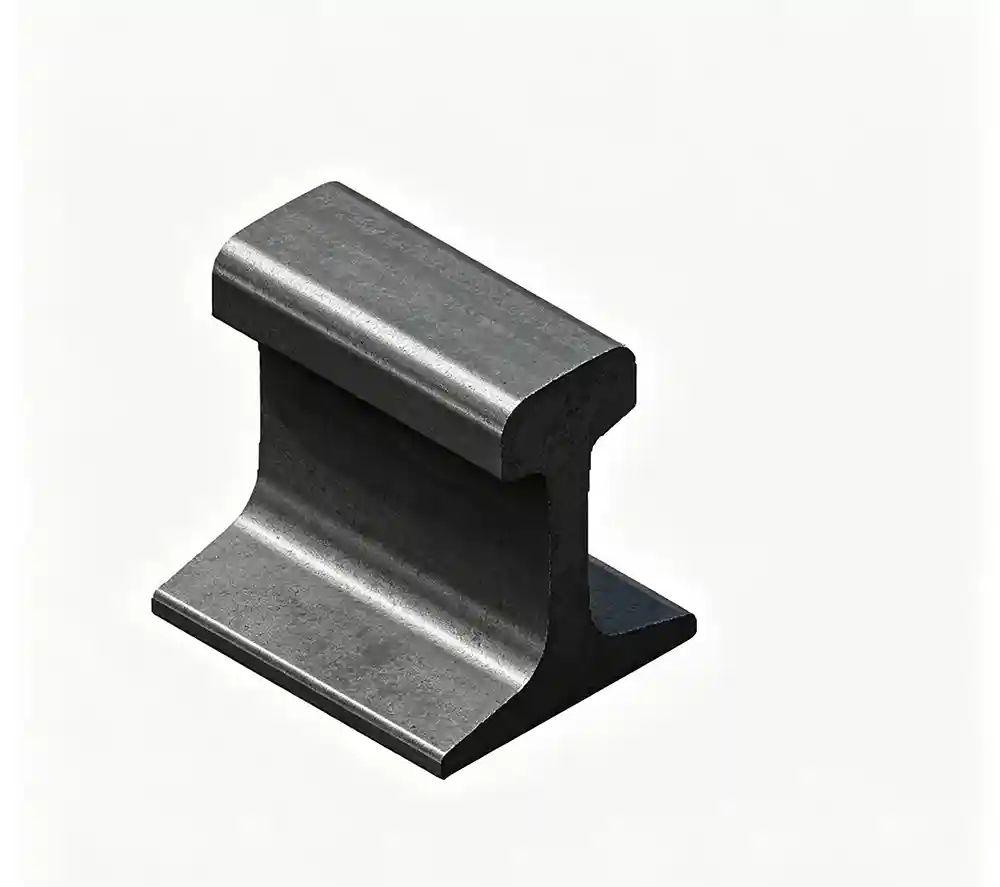
ASCE Series American Standard Crane Rails
Material Grades: 700, 900A, and 1100
Rail Sizes: ASCE 25, ASCE 30, ASCE 40, ASCE 50, ASCE 60, ASCE 70, ASCE 80 and ASCE 85.
Standard Lengths: Common supply lengths range from 6 to 12 meters, with extended lengths available up to 25 meters.
Applicable Standards: ASCE, and ASTM A1(for 60 lb. and above rails)
Complete Rail Accessories Available: Glory Rail provides a full range of rail system accessories, including:
- Rail clips with rubber noses and weldable base clips
- Elastic rubber rail pads
- Soleplates and base plates
- Fish plates (joint bars) for rail connections
- Bolts and nuts for fastening systems
- Leveling bolts for precise rail alignment
Applications: Suitable for light to medium-duty crane systems, industrial rail tracks, and material handling equipment.
If you require special rail lengths, higher-strength material grades, or customized machining services, please contact us for tailored production solutions.
What is ASCE Rail?
ASCE rail sizes are identified by weight—ASCE 60, for example, weighs 60 pounds per yard (lb/yd). Built to standards set by the American Society of Civil Engineers, these rails are widely used in industrial track applications.
Key Features of ASCE Series Rails
1.Superior Material Composition
Constructed from high-carbon steel alloys (55Q or U71Mn), ASCE Rails exhibit:
- High tensile strength (up to 880 MPa for U71Mn)
- Enhanced resistance to surface abrasion and fatigue cracks
- Exceptional impact absorption capabilities, reducing maintenance costs over lifecycle.
2.Environmental Resilience
ASCE Rail performs reliably in diverse conditions:
- Arctic environments with specialized low-temperature treatments
- Coastal applications featuring advanced corrosion protection
- Tropical climates with enhanced oxidation resistance
Key Specifications of ASCE Rails
ASCE rails are T-rails (Tee rails) with a flat-bottomed design. Their typical characteristic is that the rail height equals the web width, with a cross-sectional weight distribution of approximately: rail head 42%, rail web 21%, and rail base 37%.
| Size | Rail height(mm)A | Bottom Width(mm)F | Head Width(mm)C | Web Thickness(mm)t | Steel Grade | Weight(kg/m) |
|---|---|---|---|---|---|---|
| 69.85 | 69.85 | 38.1 | 7.54 | 55Q | 12.2 | |
| 79.37 | 79.37 | 42.86 | 8.33 | 55Q | 15.2 | |
| 88.9 | 88.9 | 47.6 | 9.90 | 55Q | 19.84 | |
| 93.66 | 93.66 | 50.8 | 10.72 | 55Q | 22.3 | |
| 98.43 | 98.43 | 54.00 | 11.11 | 55Q | 24.855 | |
| 107.95 | 107.95 | 60.33 | 12.3 | 55Q | 30.1 | |
| 117.48 | 117.48 | 61.91 | 13.1 | 55Q | 34.5 | |
| 122.24 | 122.24 | 62.71 | 13.49 | 55Q | 37.2 | |
| 127.00 | 127.00 | 63.50 | 13.89 | U71Mn | 39.82 | |
| 131.76 | 131.76 | 65.09 | 14.29 | U71Mn | 42.3 |
Crane Rail Detailed Dimensions for Standard: ASTM A1 ASCE Rail.
| Steel Grade | C(%) | Si | Mn | Cr | V | P | S | Tensile Strength (Rm/MPa) |
|---|---|---|---|---|---|---|---|---|
| 50Mn | 0.48-0.56 | 0.17-0.37 | 0.70-1.00 | – | – | ≤0.035 | ≤0.035 | ≥645 |
| U71Mn | 0.65~0.76 | 0.15~0.58 | 0.70~1.40 | – | – | ≤0.035 | ≤0.030 | ≥880 |
| 900A | 0.60-0.80 | 0.10-0.50 | 0.80-1.30 | – | – | ≤0.040 | ≤0.040 | ≥880 |
| U75V | 0.71~0.80 | 0.50~0.80 | 0.75~1.05 | – | 0.04~0.12 | ≤0.035 | ≤0.030 | ≥980 |
| U78CrV | 0.72~0.82 | 0.50~0.80 | 0.70~1.05 | 0.30~0.50 | 0.04~0.12 | ≤0.035 | ≤0.030 | ≥1080 |
| U77MnCr | 0.72~0.82 | 0.10~0.50 | 0.80~1.10 | 0.25~0.40 | – | ≤0.035 | ≤0.025 | ≥980 |
| U76CrRE | 0.71~0.81 | 0.50~0.80 | 0.80~1.10 | 0.25~0.35 | 0.04~0.08 | ≤0.035 | ≤0.025 | ≥1080 |
ASCE vs. AREMA Rail Standards: Key Differences
As North American railway standards have evolved, AREMA has gradually replaced ASCE as the mainstream standard for heavy-haul mainlines; however, ASCE remains practical for light industrial tracks and crane applications due to its well-established specification system. The key differences between the two are as follows:
| Feature | ASCE Rail | AREMA Rail |
|---|---|---|
| Standards Organization | American Society of Civil Engineers | American Railway Engineering and Maintenance-of-Way Association |
| Design Focus | Light/medium duty, cost-optimized | Heavy-haul/high-speed, life-cycle optimized |
| Head Profile | Relatively flat (prone to stress concentration) | Optimized curvature (minimizes contact stress) |
| Typical Sections | ASCE 60 / 75 / 85 | 115 RE / 136 RE / 141 RE |
| Primary Applications | Branch lines, industrial yards, crane runways | Mainlines, heavy freight corridors, high-speed rail |
ASCE Rails for Crane Applications
1. Light- to Medium-Duty Workshop Cranes
This is the most common application. In mechanical manufacturing, assembly shops, or warehousing and logistics centers, for overhead cranes with relatively low lifting capacities (typically ≤20 tons), selecting ASCE 40 or ASCE 60 rails is often more cost-effective than heavy-duty railway rails (such as 115 RE).
Advantages: The moderate cross-sectional dimensions can withstand standard wheel loads while facilitating installation on concrete or steel beams. Additionally, the procurement of supporting fasteners, such as clamps and bolts, is well-established.
2. Outdoor Gantry Cranes and Precast Yards
In precast component plants, gravel yards, or small-to-medium-sized docks, ASCE 60/75/85 is commonly used for the travel tracks of gantry cranes.
Rationale: These sites typically require tracks with good wear resistance and impact resistance, though not necessarily at the level required for heavy-duty container cranes in ports. As long as wheel loads are kept within a reasonable range (e.g., under 30,000 lbs), the “flat-bottomed + equal-height” design of ASCE rails provides sufficient lateral stability, and installation and maintenance are relatively straightforward.
3. Renovation of Older Facilities and Replacement of Spare Parts
In North America and industrial projects influenced by its standards, the crane tracks in a large number of existing factory buildings were originally designed according to ASCE standards.
Practical Value: When upgrading equipment or replacing tracks, adhering to the original standards (such as ASCE 40) avoids the need to redesign supports and fasteners, significantly reducing renovation costs and downtime. Additionally, on-site technicians are very familiar with the alignment and welding processes for these types of tracks.
4. Auxiliary and Temporary Tracks
For loop tracks used with electric hoists or jib cranes during maintenance, or for temporary guide rails during construction, small-section models such as ASCE 25/30 are highly practical.
Features: Individual sections are lightweight, allowing for manual or small-scale mechanical handling and installation, while their stiffness is sufficient to withstand occasional off-center loads or impacts.
When to Consider Heavier Rail Standards
ASCE rails work well for many industrial applications, but some operating conditions may require stronger rail profiles such as DIN crane rails.
You may need to upgrade when:
- Continuous operation with frequent loading and unloading, especially for container cranes or heavy equipment in steel plants.
- Harsh site conditions such as molten metal exposure, high ambient temperatures, or corrosive environments.
- Wheel loads above 40,000 lbs, or applications that demand reliable performance at higher travel speeds.
We Supply A Full Range of Crane Rails
| Crane Rail Type | Standard | Available Sizes | Material | Standard Length | Typical Application |
|---|---|---|---|---|---|
| QU Series | Chinese YB/T 5055-2014 | QU70, QU80,QU100, QU120 | U71Mn, U75V | 12m | Overhead & Steel Mill Cranes |
| A Series | German DIN536 | A45, A55, A65, A75, A100, A120, A150 | 50Mn, U71Mn | 10m / 12m / 15m | Heavy-Duty Crane Systems |
| ASCE Series | ASTM A1 / AREMA | ASCE25, ASCE30, ASCE40, ASCE50, | 700 / 900A / 1100 | 6m – 25m | Industrial Crane Rails |
| UIC Series | UIC860-0 / EN13674-1 | UIC50 / UIC54 / UIC60 | 900A / 1100 | 12m – 25m | Industrial & Transport Systems |
| BS Series | British BS11-1985 | BS50’O’, BS60A, BS60R, BS75A, BS75R, BS80A, BS100A, BS113A | 700 / 900A | 8m – 25m | Port & Shipyard Cranes |
| JIS Series | Japanese JIS E1103/1101 | 15kg, 22kg, 30A, 37A, 50N,CR73, CR100 | According to JIS | 9m – 10m | Light Industrial Rail Systems |
| AS Series | Australian AS1085 | 31kg, 41kg, 47kg, 50kg,53kg, 60kg, 66kg, 68kg,73kg, 86kg, 89kg | 900A / 1100 | 8m – 25m | Heavy Industrial Rail Systems |
| ISCOR Series | South African ISCOR | 15kg, 22kg, 30kg,40kg, 48kg, 57kg | 700 / 900A | 9m – 25m | Mining & Industrial Tracks |
Rail Processing and System Supply Capability
Custom Processing & System Supply
Glory Rail provides ASCE rails with in-house processing capabilities including cutting, drilling, bending, surface painting, and hot-dip galvanizing. Rails can be supplied in non-standard lengths or pre-machined according to installation drawings, including pre-drilled hole layouts for direct field assembly.
Rail Fastening Components & Project Supply
A complete range of rail fastening components is available, including rail pads, soleplates, tie bars, fish plates, bolts, nuts, and leveling systems, supplied as a matched system for crane rail installation projects. With over 20 years of experience in crane rail systems, Glory Rail has supported projects across Saudi Arabia, the UAE, Turkey, the Czech Republic, Bangladesh, Australia, and Ghana, covering a wide range of industrial applications.