
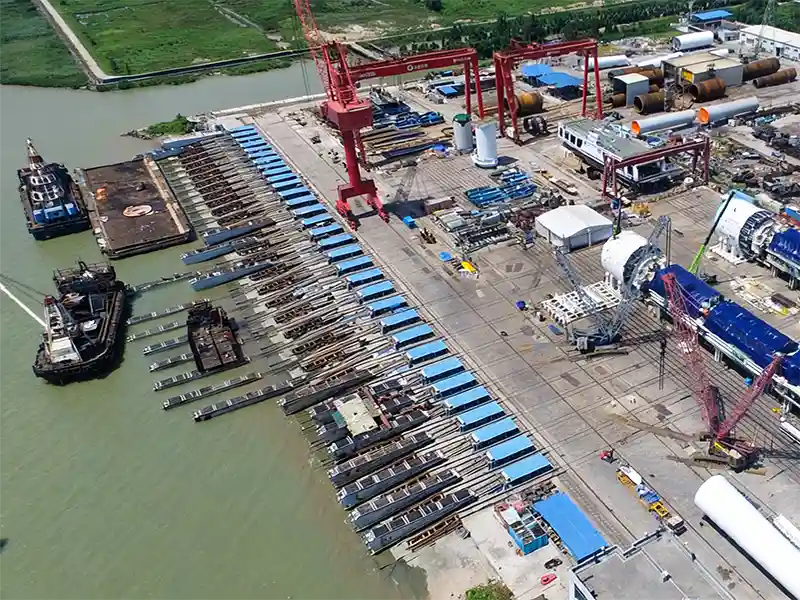
In medium and small-scale shipyards, the safe transition of a vessel from land to water (and vice versa) depends on a specialized heavy-load infrastructure: the rail-mounted mechanized slipway. Unlike the astronomical capital expenditure required for dry docks, this system utilizes a combination of heavy-duty crane rails and synchronized ship carriages to provide a stable, cost-effective, and highly controllable solution for inland and coastal ship construction and repair.
The operational logic is straightforward yet rigorous: high-strength steel rails serve as the foundation, dedicated carriages support the hull, and a mechanical traction system (winches) ensures a smooth, governed movement that far exceeds the safety margins of traditional gravity-fed timber slipways.
1. The Foundation: Why Heavy-Duty Crane Rails are Mandatory
1.1 Rail Selection: QU and DIN Series vs. Standard Tracks
A vessel can weigh anywhere from several hundred to several thousand tons. Standard industrial or railway tracks lack the sectional properties to withstand such concentrated point loads. Therefore, slipways must utilize heavy-duty crane rails, typically the QU series (e.g., QU100, QU120) or international equivalents like the DIN 536 series (e.g., A100, A120).
These rails are characterized by a wider head and a thicker web, specifically designed to:
- Distribute Enormous Wheel Loads: Capable of sustaining tens of tons per wheel without deformation.
- Resist Lateral Stress: Maintaining alignment even when the hull’s center of gravity shifts during the transition to water.
- Endure Marine Corrosion: Often treated or selected with high-grade carbon steel to withstand the wet/dry cycles of the splash zone.
1.2 Layout and Gradient Design
The slipway is engineered as a gentle inclined plane extending from the onshore “berth area” to a specific depth underwater.
- The Gradient: Typically fixed between 1:15 and 1:20. This slope is steep enough to allow gravity to assist in launching but shallow enough to prevent “runaway” momentum.
- The Substructure: Rails are mounted on reinforced concrete sleepers and deep-pile foundations to prevent subsidence under the weight of a loaded carriage. Usually, 2 to 4 parallel rail lines are laid to ensure the hull is supported evenly across its breadth.
2. Load-Bearing Components: The Ship Carriage System
The “wheels” beneath the ship are not individual components but part of a sophisticated ship carriage (or slipway cradle). These are custom-engineered heavy-load units that travel exclusively along the crane rail path.
2.1 Configuration and Redundancy
Carriages are arranged in tandem. Depending on the vessel’s length, a group of carriages is positioned every 6 to 10 meters. To ensure a safety buffer, the total load capacity of the carriage array is typically rated at 1.2x the vessel’s maximum lightship weight, effectively eliminating the risk of structural failure during transit.
2.2 Structural Anatomy
- Heavy-Duty Chassis: A rigid steel frame designed to interface with the hull’s keel or bilge blocks.
- Multi-Axle Forged Steel Wheels: Precision-machined to match the profile of the heavy-duty crane rail, minimizing rolling resistance and maximizing contact surface.
- Hydraulic Leveling (Optional): Advanced systems feature articulated or hydraulic frames. These allow the lower half to follow the 1:20 slope while the upper half keeps the vessel horizontal, preventing structural stress on the hull during the transition from the horizontal berth to the inclined slipway.
3. Operational Workflow: Launching and Hauling
The entire system is governed by a top-side winch and wire rope system. Unlike “free-drop” methods, this is a forced-motion system where speed is strictly regulated.
3.1 Launching (Newbuilds)
- Transfer: The completed hull is transferred onto the carriages. Temporary supports are removed.
- Transition: The carriages move the ship to the “threshold” where the horizontal track meets the incline.
- Controlled Descent: The winch slowly pays out the cable. The ship descends at a controlled rate of 0.5–1.5 meters per minute.
- Float-off: As the carriages enter the deep-water section, the vessel gains buoyancy. Once fully afloat, the carriages are disconnected and winched back to shore.
3.2 Recovery (Repair/Maintenance)
- Alignment: The vessel is positioned over the submerged carriages using tugs or mooring lines.
- Seating: As the winch pulls the carriages up the incline, the hull “seats” onto the blocks. Divers or sonar often verify the positioning.
- Hauling: The winch pulls the loaded carriages up the heavy-duty crane rails until the vessel is completely clear of the water and moved to the horizontal repair berth.
4. Why This System Dominates the Mid-Market
The rail-mounted mechanized slipway remains the “gold standard” for small and medium shipyards due to:
- Versatility: One system handles both the birth of a ship and its mid-life maintenance.
- Safety: The use of heavy-duty crane rails combined with mechanical traction provides a predictable, low-risk environment.
- Space Efficiency: Allows for multiple vessels to be stored in a “parking” configuration on shore, serviced by a single slipway via transverse transfer tracks.
5. Conclusion
The success of a mechanized slipway lies in the synergy between mechanical precision and structural integrity. At the heart of this integrity is the rail. Without high-quality heavy-duty crane rails, the immense pressure of a ship’s hull would compromise the foundation, leading to catastrophic derailment or structural damage.
For shipyards looking to build or upgrade their slipway infrastructure, selecting the correct rail profile is the most critical decision in the design phase. Glory Rail is a premier provider of specialized track solutions, offering a comprehensive range of heavy-duty crane rails to meet international standards. Whether your project requires the QU series (QU70, QU80, QU100, QU120) or the European DIN 536 series (A45 through A150), Glory Rail provides the high-strength, wear-resistant steel necessary to keep your shipyard operations moving safely and efficiently.