
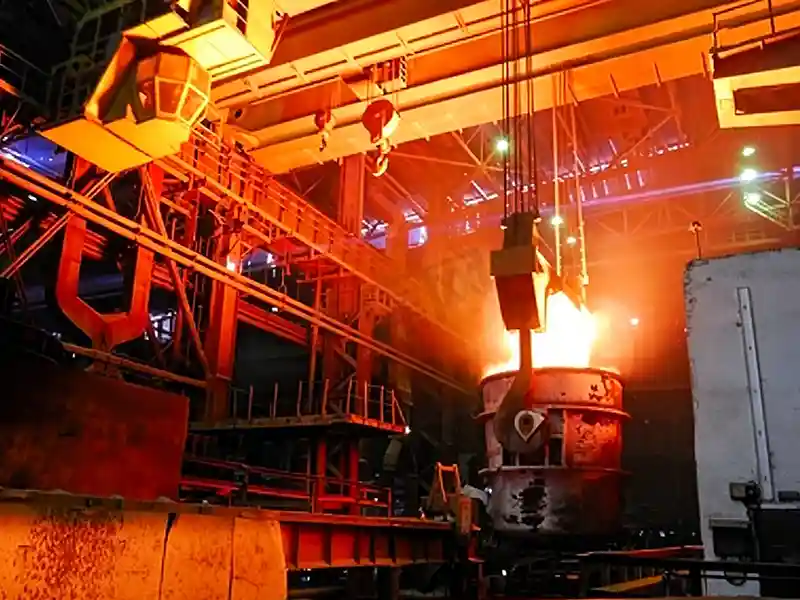
Choosing a crane rail for steel mill casting shop starts with one fact: ordinary rails do not last here. The rail runs directly under ladles carrying 200+ tons of molten steel. Radiant heat at rail level reaches 300–500°C. Wheels pass over it hundreds of times per shift, with sudden starts and stops. Iron oxide dust and slag cover everything.
A standard industrial rail will fail quickly. But the right rail, installed correctly, can last decades.
This guide covers four things: which rail profile, which steel grade, how to manage heat, and what to check during maintenance.
1. What Makes a Casting Shop Different?
Before picking a rail, understand the environment. Four factors separate a casting shop from a normal crane runway:
| Factor | Casting Shop Condition | Why It Matters |
|---|---|---|
| Load | Wheel loads often exceed 200–400 kN | Rail must resist plastic deformation (mushrooming) |
| Heat | Radiant heat 300–500°C from ladles | Rail expands, lubricants fail, foundation weakens |
| Shock | Abrupt crane starts/stops | Cyclic impact accelerates fatigue cracking |
| Contamination | Iron oxide dust, slag, metal debris | Accelerates wear and corrosion, jams fasteners |
The key insight: you don’t need a “heat-resistant” rail steel in most cases. You need a strong, wear-resistant rail plus external heat management. More on that later.
2. Crane Rail Profiles: Which One for Casting Shop?
Globally, three standard families dominate crane rail for steel mill applications. Here’s how they compare:
| Standard | Common Models | Head Width | Height | Base Width | Weight (kg/m) | Typical Use |
|---|---|---|---|---|---|---|
| Chinese GB (YB/T 5055) | QU70, QU80, QU100, QU120 | 70–120 mm | 120–170 mm | 120–170 mm | 52.8–118.1 | Most common in Asia; QU100/120 for heavy ladle cranes |
| European DIN 536 | A75, A100, A120 | 75–120 mm | 85–105 mm | 200–240 mm | 56.2–100 | Wide base for lateral stability; popular on European-origin cranes |
| North American ASTM A759 | CR175 (175 lb/yd) | 108 mm | 152 mm | 152 mm | 86.8 | Standard for US/Canadian mills |
Quick selection rule: Match the rail profile to your crane’s wheel load and the design standard already used in your mill. Mixing standards (e.g., QU rail on DIN clips) creates fitment problems.
For a typical 200-ton ladle crane, QU100 or A100 is the minimum. For 300+ tons, go to QU120 or A120.
3. Steel Grades: Strength and Wear Come First
The steel inside the rail matters as much as the shape. Casting shop rails need high tensile strength (to resist crushing) and high hardness (to resist wear). Heat resistance is secondary.
Here are the common grades:
| Grade | Tensile Strength (MPa) | Hardness (HB) | Key Feature | Best For |
|---|---|---|---|---|
| U71Mn (Chinese) | ≥880 | 260–300 | High carbon + manganese, good toughness | General casting shop duty |
| 900A (DIN) | ≥880 | 260–300 | Similar to U71Mn | European-spec projects |
| U75V (Chinese) | ≥980 | ~300 | Microalloyed with vanadium | Higher wear resistance, frequent cycles |
| R350HT (European) | ≥1100 | 320–360 | Heat-treated head | Extreme duty, high abrasion |
| 40CrMnMo (special) | ≥600 at 400°C | – | Pearlitic heat-resistant steel | Only when radiant heat exceeds 400°C at rail surface |
What about heat? A standard U71Mn rail will begin to soften above 300–400°C. But you should never let it get that hot. That’s where thermal management comes in.
4. Thermal Management: Protecting the Rail from Heat
This is the most misunderstood part of casting shop rail design. The rail itself is not the primary defense against heat. External measures do the real work.
Four proven methods:
4.1 Under-rail insulation
Install a thermal barrier between the rail and the supporting beam. Materials include:
- Reinforced refractory slabs
- High-density calcium silicate boards
- Specially designed insulation panels
Real-world result: A 10–20 mm insulation layer dropped rail surface temperature from 350°C to 220°C in one documented installation.
4.2 Heat shields above the rail
Place removable metal shields over the rail in areas prone to slag spills. These intercept molten material before it contacts the rail.
4.3 High-temperature fastening components
Standard elastic pads soften and lose clamping force. Use:
- Heat-stabilized rail pads (rated for 200°C+)
- Weldable clips (e.g., 9216 series with captive bolts)
- High-temperature lubricants between rail and clip
4.4 Expansion joints
A continuous rail track expands significantly with heat. For runways longer than 50 meters:
| Rail Length | Expansion Gap Recommendation |
|---|---|
| 50–100 m | One expansion joint in the middle |
| 100–200 m | Two joints, spaced evenly |
| >200 m | Every 20–30 meters |
Fill gaps with high-temperature silicone sealant to keep debris out.
The bottom line: If you manage heat externally, a standard U71Mn or 900A rail works fine. If you skip insulation, even an expensive heat-resistant rail will eventually fail.
5. Installation: Three Things to Get Right
No matter how good the rail is, bad installation ruins it. Focus on these three:
5.1 Foundation level and straightness
- Use laser measurement tools during installation.
- Tolerances: Straightness within ±1 mm per meter, gauge accuracy within ±2 mm total.
- Uneven foundation = twisted rail = uneven wheel contact + rapid side wear.
5.2 Fastening system selection
| Beam Type | Recommended Fastening | Why |
|---|---|---|
| Steel girder | Welded clips (e.g., W220, 9216) | No loosening from vibration; permanent alignment |
| Concrete beam | Bolted embedment with epoxy anchors | Allows adjustment; requires torque monitoring |
5.3 Continuous welded rail vs. jointed rail
- Welded rail: Fewer impact points, less wear on wheels and rail, lower maintenance. Requires preheating and post-weld stress relief.
- Jointed rail: Easier to install and replace, but each joint is a wear hotspot. Acceptable for short runways or light-duty cranes.
For casting shops with heavy cranes and 24/7 operation, continuous welded rail is worth the extra installation cost.
6. Maintenance: What to Check and When
A simple inspection schedule prevents most failures.
Monthly visual checks:
- Obvious cracks or spalls on rail head
- Loose clips or missing bolts
- Debris buildup around expansion joints
- Signs of overheating (discolored rail, melted pads)
Quarterly dimensional checks:
| Measurement | Tool | Acceptable Range |
|---|---|---|
| Gauge (distance between rails) | Gauge rod | ±3 mm from design |
| Head wear depth | Rail wear gauge | < 10% of original head height |
| Rail straightness | Straightedge + feeler | < 1 mm per meter |
Annual full survey:
- Measure elevation along entire runway (check for foundation settlement)
- Record wear patterns (photo documentation helps)
- Torque all clips to spec (use a torque wrench, not guesswork)
When to replace: If head wear exceeds 10–15% of original section, or if cracks reach 5 mm depth. Don’t wait for a broken rail—that’s a crane derailment waiting to happen.
7. Conclusion
Crane rail for steel mill casting shop selection comes down to three things: the right profile for your wheel load, the right steel grade for wear resistance, and proper thermal management to keep heat away from the rail itself. Skip any of these, and you will pay for it in early failure and unplanned downtime.
That is exactly where Glory Rail focuses. We supply high-quality crane rails — including QU70–QU120, A75–A120, and CR series — with full mill test certificates and customized lengths. We also provide technical support on profile matching, fastening systems, and thermal protection solutions for demanding environments like steel mills, ports, and heavy industrial plants.