
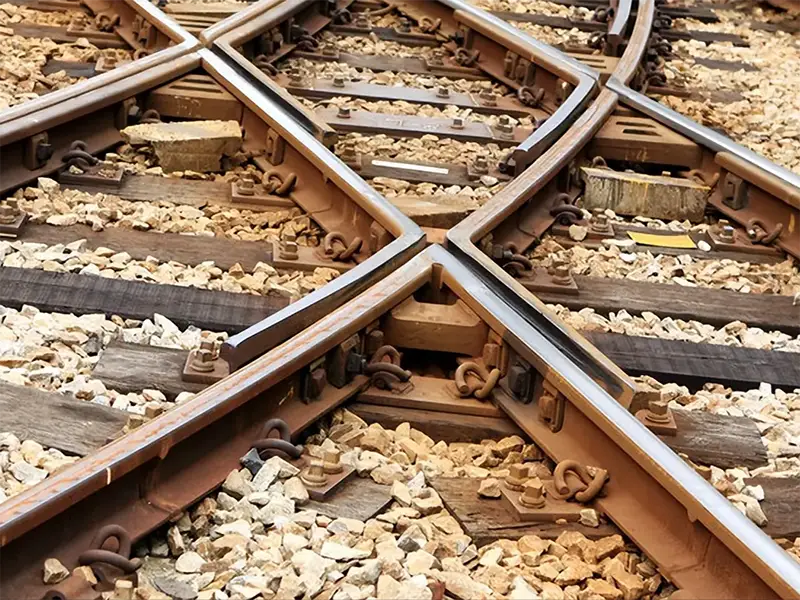
Railway ballast is the foundational layer of crushed stone you find beneath the railroad tracks. It plays several critical engineering roles in keeping railways safe and stable. This article will explain what railway ballast is, detail its five key functions, explore why crushed stone is the chosen material, and highlight why this layer is non-negotiable for any durable railroad.
The Five Essential Functions of Railway Ballast
This bed of stones is a multi-tasking workhorse. Each function addresses a specific physical challenge of running heavy trains.

1. Distributing Load and Reducing Pressure
A train’s weight concentrates immense force on the small contact points of the sleepers (ties). The underlying soil often cannot support this intense pressure. Railway ballast solves this by spreading the load. It acts like a platform, transferring the force from the sleepers over a much wider area of the subgrade. Using the principle of pressure = force / area, it significantly reduces the stress on the weaker ground below, preventing sinking and deformation.
2. Preventing Track Movement (Track Creep)
Train tracks face constant forces trying to shift them. On curves, lateral forces push the track outward. On slopes, traction and braking forces can cause longitudinal movement. The ballast, tightly packed around and under the sleepers, provides crucial friction and interlock. This “locks” the track in place, maintaining its correct alignment and gauge under dynamic loads.
3. Absorbing Shock and Vibration
The contact between steel wheels and steel rails is extremely hard. Joints, imperfections, and irregularities create sharp impacts and vibrations. These dynamic forces can be double the train’s static weight. Without a cushion, they would rapidly damage rails, fasteners, and degrade the roadbed. Railway ballast acts as a damping layer. Its granular nature allows particles to shift minutely, absorbing and dissipating this energy before it can cause harm.
4. Providing Superior Drainage
Water is a primary threat to track stability. A wet subgrade becomes soft and loses strength. A key feature of railway ballast is its high permeability. The voids between the crushed stones allow water from rain or runoff to drain rapidly down and away from the critical zone beneath the sleepers. This keeps the foundation dry and strong. While drainage ditches are part of the system, the ballast itself is the first and most important drainage layer.
5. Enabling Efficient Maintenance
Railway lines require constant adjustment to maintain perfect geometry, such as superelevation on curves or general level. A ballasted track makes this straightforward. Maintenance crews can easily lift, level, or align tracks by adding, removing, or tamping (compacting) the stones. This flexibility offers a major practical and economic advantage over concrete slab tracks, which are far more complex and costly to adjust after installation.
Why Crushed Stone? The Engineering Rationale
Crushed, angular stone is specifically chosen for railway ballast because its properties perfectly match the required functions:
- Strength & Durability: The stones are hard and resist breaking down under repeated heavy loads. Their angular shape is crucial.
- Interlock & Stability: The sharp, irregular edges allow the stones to lock together tightly, creating a stable, non-shifting platform that resists track creep.
- Optimal Drainage: The graded sizes and angular shapes create consistent void spaces for fast water passage, preventing saturation.
- Workability & Availability: It is easy to handle, place, and compact with standard machinery. Suitable hard rock (granite, basalt) is widely available, making it cost-effective.
A standard ballast profile is layered for performance. The top ballast (shoulder and crib) anchors the sleepers. The sub-ballast layer beneath uses slightly smaller stones to further transition loads and filter fine particles, protecting the main layer.

Conclusion: The Indispensable Foundation
Railway ballast is far from mere rubble. It is a precisely engineered layer that performs the vital, combined roles of a load distributor, track stabilizer, shock absorber, drainage system, and adjustable foundation. Every train journey relies on the integrity of this crushed stone bed. It ensures that the immense forces of moving loads are safely managed, making it an absolutely essential component in the science and safety of railway infrastructure.