
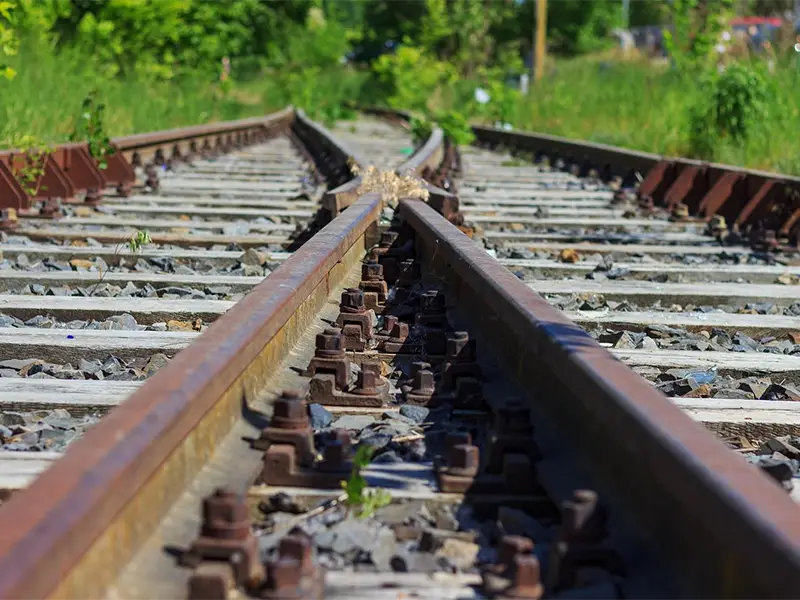
The Surprising Truth Behind Those “Rusty” Rails. If you’ve ever stood beside railroad tracks — whether an old freight corridor or a newly laid high-speed line — you’ve probably noticed it: the rails look rusty. At first glance, they resemble old iron, weather-beaten and corroded. This often sparks a natural question:
“Why don’t they just use stainless steel? Wouldn’t that last longer and look cleaner?”
It’s a reasonable assumption — but the reality involves a careful balance of metallurgy, mechanics, economics, and real-world performance. Let’s break it down.
✅ First Things First: Railroad Tracks Aren’t Iron — They’re High-Performance Steel
Before diving into why not stainless, let’s correct a common misconception:
Railroad tracks (also called railway rails, train tracks, or railroad rails) are not made of “iron” — they’re made of specialized carbon steel, typically high-manganese steel (e.g., UIC 900A, or Chinese standard U71Mn).
Common Rail Steel Grades Worldwide
Used for mainline railroad tracks (railway rails / train tracks), not crossings or frogs
| Grade | Standard / Region | Typical Composition (wt%) | Key Features & Applications |
|---|---|---|---|
| R260 | EN 13674-1 (Europe) | C: 0.67–0.80, Mn: 0.90–1.20, Si: ≤0.50 | Base-grade rail; cold-rolled; widely used on medium-traffic lines. Good weldability and cost efficiency. |
| R350HT | EN 13674-1 (Europe) | C: 0.75–0.85, Mn: 0.80–1.20, Cr: 0.20–0.50 | Heat-treated (online/offline); UTS ≥1100 MPa; 30–50% longer life than R260. Standard for high-speed (TGV, ICE) and heavy-haul lines. |
| Grade 260 | AREMA (North America) | C: ~0.77, Mn: ~1.0–1.2, Si: ~0.2 | Equivalent to R260; used with rail sections like 115RE, 136RE. Common on Class I freight networks. |
| Grade 350 | AREMA + Mill Specs (USA/Canada) | C: 0.78–0.83, Mn: 0.90–1.20, Cr: 0.2–0.6, + V/Nb (microalloyed) | TMCP or heat-treated; UTS ~1180–1280 MPa. For demanding curves, heavy axle loads (>33 ton), and high-tonnage corridors. |
| BH Rail (Bainitic) | JIS E 1101 (Japan), adopted in EU/India | C: 0.65–0.80, Mn: 1.0–1.4, Cr/Mo/Ni (optional, mill-specific) | Bainitic microstructure; high strength (UTS ~1250–1350 MPa) + superior fracture toughness. Used on Shinkansen curves and high-wear segments. |
| U71Mn | GB/T 2585 (China) | C: 0.65–0.77, Mn: 1.10–1.40, Si: 0.15–0.35 | Work-hardening carbon-manganese rail; standard for 50kg/m, 60kg/m rails on Chinese mainlines. Comparable to R260/R350 in performance. |
| U75V | GB/T 2585 (China) | C: 0.67–0.77, Mn: 0.70–1.00, V: 0.04–0.12 | Vanadium-microalloyed; higher strength & fatigue resistance than U71Mn. For high-speed (e.g., Beijing–Shanghai HSR) and heavy-haul lines. |
This alloy — usually containing 0.6–1.3% carbon and 0.8–1.4% manganese — delivers exactly what rail infrastructure demands:
- Exceptional hardness to resist deformation under heavy axle loads (up to 35+ tons per wheel!)
- High wear resistance against millions of wheel passes over decades
- Controlled toughness to avoid brittle fracture in cold climates
- Work-hardening ability: the surface gets harder with use — a unique advantage of manganese steel
So when you see that reddish-brown patina? It’s surface oxidation — not decay. In fact, that thin rust layer often acts as a passive barrier, slowing further corrosion beneath. The rail core remains sound, strong, and fully functional.
❌ Why Stainless Steel Isn’t Suitable for Mainline Railroad Tracks
Despite its name, stainless steel isn’t “stain-proof” — and more importantly, it’s simply not engineered for this job. Here’s why:
🔧 1. Mechanical Performance Gaps
Most stainless grades (especially common austenitic types like 304/316) are softer and less wear-resistant than rail steel. Under repeated high-contact stress from train wheels, they’d deform, groove, or spall far faster.
🌡️ 2. Thermal Expansion Challenges
Stainless steels generally have higher coefficients of thermal expansion than carbon rail steel. In long, continuously welded tracks (CWR), this increases the risk of buckling in summer heat or pull-aparts in extreme cold — critical safety hazards.
💰 3. Cost Is Prohibitive
Stainless rail would cost 3–5× more than standard rail steel. With thousands of kilometers of track worldwide, that premium adds up to billions — for no net gain in service life or safety.
⚙️ 4. Unnecessary Corrosion Resistance
Railroads operate in open, well-drained environments. While moisture and salt accelerate surface rust, structural corrosion is rarely the failure mode. Rails are more likely to be retired due to head wear, fatigue cracks, or gauge widening — not rust-through.
📌 Fun fact: Some specialty applications do use stainless or corrosion-resistant alloys — like coastal metro systems (e.g., parts of Hong Kong MTR) or chemical plant sidings — but these are exceptions, not the rule.
♻️ Smart Engineering > Material Prestige
Good engineering isn’t about using the “shiniest” material — it’s about matching performance to purpose.
- ✅ Rail steel = optimized for load, wear, fatigue, and cost
- ✅ Surface rust = mostly cosmetic; doesn’t compromise integrity
- ✅ Maintenance strategies (grinding, lubrication, ultrasonic inspection) extend rail life far more effectively than material substitution
And when extra protection is needed? Engineers use proven, cost-effective methods like:
- Rail greasing at curves to reduce wear & corrosion
- Drainage optimization to minimize water pooling
- Selective coatings in aggressive environments (e.g., galvanized fasteners)
Final Thought: Rust Isn’t Weakness — It’s Proof of Smart Design
Those “rusty” rails you see? They’re not neglected — they’re performing as intended. The slight discoloration is a small trade-off for decades of reliable, safe, and economical service.
Next time you hear a train rumble past, remember: that familiar clatter isn’t just sound — it’s the voice of precision metallurgy, working exactly as designed.
🚂 Built to last — not to shine.
Want to learn more about railway infrastructure, rail steel specifications (like UIC60,115RE,38kg/m, 50kg/m, or 60kg/m rails), or how modern tracks are maintained?
👉 Contact Glory Rail— we supply certified rail products worldwide, with inventory ready for fast dispatch.