
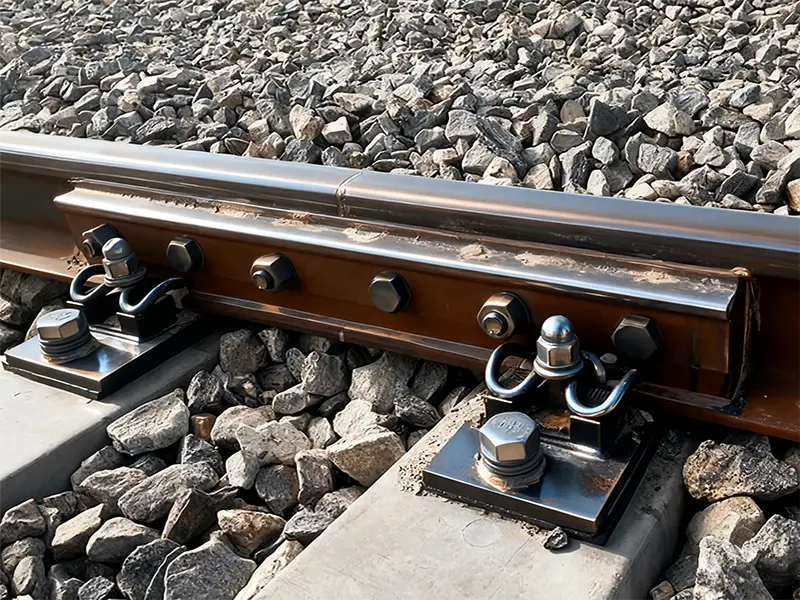
Every inch of railway track depends on how well its rail connect system works. From the bolts and fish plates to insulated joints and expansion devices, each component ensures smooth train movement and long-lasting stability.
A proper rail connect doesn’t just hold rails together—it balances strength, flexibility, and expansion to handle pressure, vibration, and temperature changes. Let’s break down the types, structures, and evolution of these essential connections.
1. Types of Rail Joints and Connections
Rail joints come in different designs depending on where and how they’re installed. Based on sleeper position, they fall into two main types:
- Suspended joints, placed between sleepers
- Supported joints, located directly above a sleeper
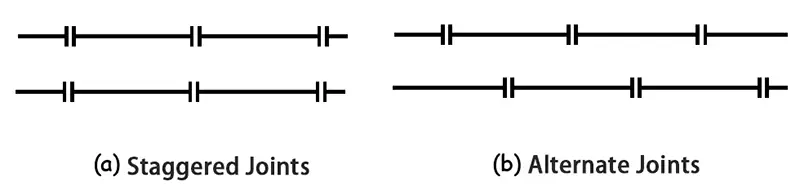
Rails can also be joined opposite or staggered, though China’s standard design mainly uses opposite suspended joints for stability and alignment.
2. Common Types of Rail Connections
2.1 Standard Rail Joint
The most basic and widely used form, a standard rail joint, connects two rail ends using fish plates, bolts, and spring washers.
🔩 Fish Plates and Their Role
Fish plates (also called joint bars) take on bending stress and transmit longitudinal forces. They prevent excessive rail movement while allowing just enough flexibility for thermal expansion.
The most common type in modern railways is the double-head slope-supported fish plate.
Its advantages:
- High resistance to vertical bending and horizontal displacement.
- Self-tightening ability when slightly worn—tightening the bolts again restores stability.
Each fish plate typically has six bolt holes—a mix of round and elongated ones—to maintain the correct expansion gap.
2.2 Insulated Rail Joint
Insulated joints separate signal circuits between track sections. They come in two main forms:
- Ordinary high-strength insulated joints
- Bonded (glued) insulated joints
🧱 Factory-Bonded vs. On-Site Bonded
- Factory-bonded jointsare made under controlled heat and pressure, ensuring precise bonding between rails, fish plates, and insulation layers.
- On-site bonded jointsuse high-strength adhesive and bolts for field assembly—ideal for long continuous welded rails.
Bonded insulated joints increase joint strength, improve insulation, and extend track life.
2.3 Frozen Rail Joint
Frozen joints “lock” rails in place to limit expansion—important for extreme climates or seamless tracks.
🧊 Two Main Types
- Conventional frozen jointuses special shims to close the gap between rails, stopping movement.
- Modern frozen jointrelies on high-strength bolts and anti-loosening systems (like Huck fasteners) to provide strong friction between rails and fish plates.
These newer designs make rail connections more stable and reduce maintenance issues, especially on high-speed and heavy-load lines.
2.4 Transition (Special-Shaped) Rail Joint
Also called transition joints, these connect two rails of different sizes—say, P60 to P50 profiles.
Each end of the special-shaped fish plate matches a different rail section, ensuring a smooth top line and consistent gauge.
2.5 Expansion Rail Joint
Known as a rail expansion device or temperature compensator, this joint allows rails to expand or contract with temperature changes.
⚙️ How It Works
The system uses a basic rail and a movable tongue rail mounted on a long base plate. As the temperature shifts, the tongue rail slides smoothly along the base.
Expansion joints are usually:
- Angular type– with beveled transitions
- Curved type– shaped with a radius between 200–500 m for smoother motion
They’re common on bridges longer than 100 m or tracks with large temperature variations.
2.6 Vibration-Reducing Rail Joint
Also called resilient joints, these feature an elevated fish plate that meets the rail head, helping wheels transition smoothly over gaps.
This reduces impact and vibration, extending both wheel and rail life—especially useful for high-speed lines.
2.7 Welded Rail Joint
In welded joints, rails are fused into one continuous piece without fish plates or bolts.
Common welding methods include:
- Flash-butt welding
- Gas pressure welding
- Thermite welding
Properly welded joints achieve nearly the same strength as the rail itself, reducing impact loads and making continuous welded rail (CWR) possible.
3. Key Components of Rail Connect Systems
3.1 Fish Plates (Joint Bars)
Fish plates are crucial in every rail connect system. They bear bending stress and transmit longitudinal forces.
The double-head sloped design provides great vertical and lateral rigidity, ensuring smooth wheel passage.
Each plate has six alternating round and elongated holes, giving precise thermal gap adjustment and secure bolting.
3.2 Rail Bolts, Nuts, and Spring Washers
Bolts and nuts fasten fish plates to the rails, while spring washers prevent loosening under vibration.
Bolts come in three grades based on tensile strength:
- Grade 8.8 → 880 MPa
- Grade 10.9 → 1040 MPa
- Grade 12.9 → 1220 MPa
They’re usually 22 mm or 24 mm in diameter, paired with Grade 10 or 10H nuts.
Bolts are installed alternately inside and outside the track to balance stress, reducing the risk of complete shear failure in derailments.
3.3 Bolt Torque Requirements
Bolts must be tightened evenly to ensure stability.
The torque should meet standard requirements—never less than 100 N·m below the specified value—to maintain joint integrity and prevent vibration loosening.
Torque Standards for Bolts in Conventional Rail Joints
Item | Unit | 25 m Rail | 12.5m | |||
Max.-Min. Track Temp. Difference >85 °C | Max.-Min. Track Temp. Difference ≤85 °C | |||||
Rail | kg/m | 60 and above | 50 | 60 and above | 50 | 50 |
Bolt Grade | — | 10.9 | 10.9 | 10.9 | 8.8 | 8.8 |
Torque | N·m | 700 | 600 | 500 | 400 | 400 |
C-value | mm | 6 | 4 | 2 | ||
Notes:
- The C-value represents the amount of free rail expansion restricted by joint resistance and ballast bed resistance.
- The torque for high-strength insulated joint bolts shall not be less than 700Nm.
⚙️ Conclusion: Why Rail Connect Systems Matter
A rail connect is more than a mechanical link—it’s a critical safety system.
Whether it’s a simple fish plate or a high-tech bonded insulated joint, every design impacts ride comfort, noise, durability, and maintenance cycles.
As railway speeds and loads keep increasing, the evolution of rail joint technology plays a major role in improving track reliability and longevity.
Choosing and maintaining the right rail connect type ensures smoother rides, longer service life, and safer