
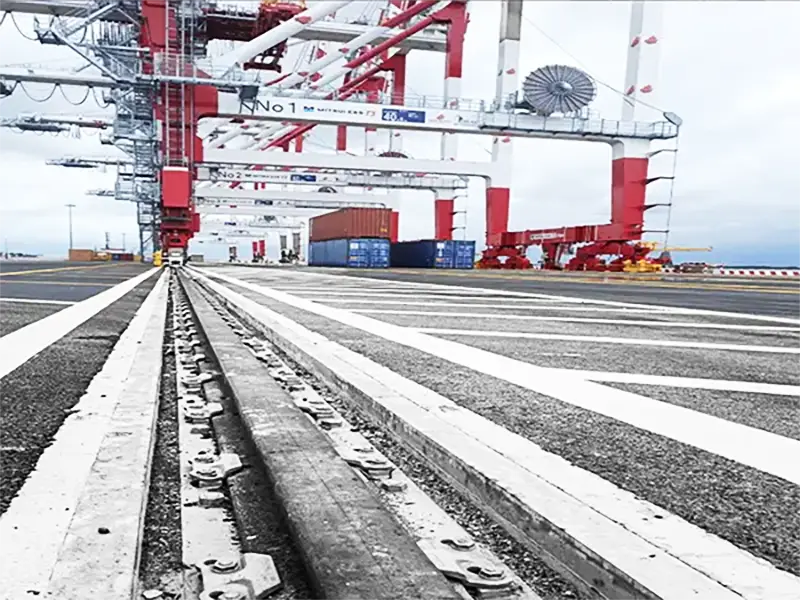
Gantry cranes are critical equipment in port operations, and the integrity of their trolley rails directly impacts operational safety and efficiency. Short rail repair is a specialized process that ensures the seamless integration of new rail sections with existing long rails. This article outlines a systematic approach to short rail repair, covering inspection, welding, installation, and quality control based on industry standards.
Inspection and Measurement
A successful repair begins with thorough inspection and measurement. Before, during, and after welding, key parameters must be checked to ensure alignment, fit, and compliance with specifications. The following components are measured:
- Weld Gap and Joint Clearance: The gap between short and long rails must be maintained within 15–20 mm to allow for proper welding and thermal expansion.
- Parallelism of Short Rails: Ensures smooth trolley movement and reduces uneven wear.
- Specification and Flatness of Rail Pads: Pads must be within tolerance to provide stable support.
- Straightness of Short Rails: Critical for avoiding trolley deviation.
- Height and Hardness of Rail Surfaces: Must match long rails to prevent step-offs and premature wear.
- Height Difference of Supporting Beams: Affects rail levelness and load distribution.
- Wear Condition of Hinge Bases: Influences alignment and stress distribution.
- Trolley Deviation and Guide Wheel Contact: Identifies misalignment early.
- Welding Parameters: Must be monitored continuously to avoid defects.
These measurements are guided by standards such as QW/GSZA-01-2012 and QW/GSZA-03-2012, ensuring that each step meets regulatory requirements before proceeding.
Welding Process Control
Welding is the most critical phase of short rail repair. Improper welding can introduce stress, distortion, or cracks, leading to failure under operational loads. Key controls include:
- Welding Parameters: Preheating, interpass and post-heat temperature and duration, current, and speed must follow procedures like GTC-18(NT) and WPS-TP08-01/02. Proper layer-by-layer deposition and full weld penetration are essential.
- Welder Skill: Certified welders with experience in rail welding are required.
- Environmental Conditions: Welding is prohibited in rain, fog, humidity over 90%, temperatures below -5°C, or wind exceeding Level 3 without protection. Condensation at night also poses a risk.
- Materials and Tools: Electrodes must be baked and stored dry. Equipment such as thermometers, ovens, and welding machines must be calibrated and maintained.
Installation Process Control
Proper installation ensures the welded rail performs as intended. Key steps include:
- Joint Alignment: The weld gap must be 15–20 mm, with straightness within 1 mm over 2 meters.
- Support Surface Flatness: Rail pads must have flatness within 5 mm over 2 meters, with over 75% contact area. Gaps between rail and support beam should not exceed 0.5 mm.
- Clamping Pressure: Rail clamps should be tightened to 30% of the specified torque to allow for weld shrinkage.
- Post-Weld Grinding: A rail grinder must be used to achieve a surface flatness of 0.5 mm over 2 meters.
- Hinge Base Height Tolerance: The height from the hinge center to the rail support surface must be within ±2 mm.
Quality Assurance
Each step—from inspection to installation—must be documented and verified. Only after passing all checks can the crane be returned to service. This systematic approach minimizes the risk of weld failure, extends rail life, and enhances operational safety.
Conclusion
Short rail repair is a precision task that demands strict adherence to process controls and standards. By implementing careful measurement, controlled welding, and precise installation, port operators can maintain gantry cranes in optimal condition, ensuring reliability and longevity. This structured methodology not only addresses immediate repair needs but also supports long-term operational excellence.
For expert short rail repair services that adhere to these rigorous standards, contact Glory Rail today.