

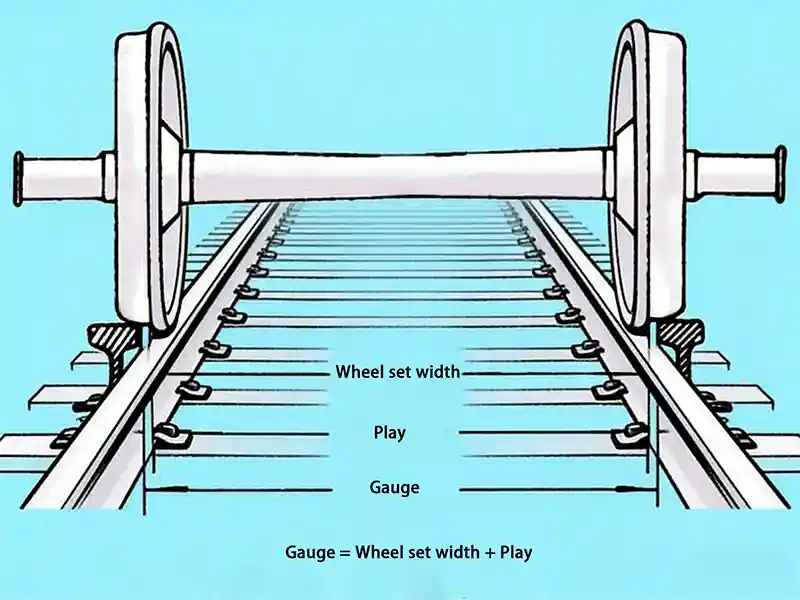
Railway track gauge refers to the distance between the inner sides of the two rails on a railway track. It is a fundamental aspect of railway engineering, as it determines the type of trains that can operate, their stability, and the load they can carry. Due to historical, geographical and engineering reasons, the gauge of rails varies around the world. These gauges play a crucial role in trunk railways as well as in industrial systems such as ports, mining and crane tracks.
Why Track Gauge Matters
The gauge of railway tracks has an impact on several key aspects of railway operation:
Stability: A wider gauge usually offers better lateral stability, allowing for higher operating speeds and heavier loads. Narrow gauges are often used in hills or restricted terrain, where sharper curves are required.
Compatibility: The train must match the gauge of the track. Vehicles specially designed for a certain gauge cannot run on other gauges without modification.
Load-bearing capacity: A wider gauge can distribute force more effectively, thereby supporting heavier freight and industrial equipment. Cost and construction: Narrow gauge construction is less costly and faster, and thus is more common in industrial lines, temporary lines or historical lines.
Common Railway Track Gauges
Railway track gauges are usually classified into standard gauge, broad gauge, and narrow gauge. Here’s an overview:
| Gauge (mm) | Gauge Name | Also Known As | Typical Regions / Countries | Typical Applications & Notes |
|---|---|---|---|---|
| 1435 mm | Standard Gauge | Normal Gauge, Stephenson Gauge, International Gauge | Mainland China, Western Europe, North America, North Africa | The most widely used gauge worldwide (~60%). Established by George Stephenson and standardized internationally in 1937. Used for mainline railways and high-speed rail. |
| 1520 mm | Russian Gauge | Broad Gauge | Russia, Belarus, Ukraine, Baltic States, Finland, Central Asia | Chosen historically for strategic and engineering reasons. Originally 1524 mm, later standardized to 1520 mm. Suited for heavy freight and long-distance transport. |
| 1600 mm | Irish Gauge | Broad Gauge | Ireland, Northern Ireland | National standard for the Irish railway network. |
| 1665–1676 mm | Iberian / Indian Broad Gauge | Broad Gauge | Spain, Portugal, India, Pakistan, Bangladesh, Sri Lanka, Argentina, Chile | Offers good stability and load capacity. Widely used in former colonies and large-scale national networks. |
| 1067 mm | Cape Gauge | Narrow Gauge | Japan, South Africa, Taiwan (China), Hong Kong (China), Indonesia, parts of Africa | Named after South Africa’s Cape Province. Common in mountainous regions. Japan mainly uses this gauge except for Shinkansen lines. |
| 1000 mm | Meter Gauge | Narrow Gauge | Vietnam, Laos, Cambodia, Thailand, Myanmar, Malaysia, Ethiopia, Cameroon | Economical for terrain-constrained regions. Widely built during colonial railway expansion. |
| 762 mm | 2 ft 6 in Gauge | Narrow Gauge | China (historical mining lines), Japan (limited), tourist railways | Known as “small railways.” Historically used in mines and industrial transport; now often preserved for tourism. |
| 600 mm | Industrial Narrow Gauge | Narrow Gauge | Industrial sites worldwide | Mainly used for temporary construction railways, mines, and industrial logistics. |
Track Gauge in Industrial and Crane Applications
In industrial settings, ports, and crane systems, track gauge is often customized rather than strictly standardized. For example:
- Crane rails may use QU70 or QU80 profiles on standard or slightly narrower gauges to fit factory layouts.
- Mining and temporary haulage tracks may use 762 mm or 1000 mm narrow gauges for flexibility and cost-efficiency.
This shows that while standard gauge dominates mainline railways, industrial and specialized rail systems adapt gauge to practical needs rather than global standards.
The Impact of Gauge Differences
Varying gauges can complicate international rail travel and freight transport. For example, trains crossing from China (standard gauge) into Kazakhstan (Russian gauge) must undergo bogie exchange or use variable gauge axles to continue their journey. This process is time-consuming and costly.
Some countries operate multiple gauges within their borders. Japan, for instance, primarily uses 1067 mm for conventional lines but adopted 1435 mm for its high-speed Shinkansen (“bullet train”) network to ensure higher stability and speed.
Conclusion
Understanding track gauge is key to knowing why trains operate differently around the world. From standard mainline railways to specialized industrial tracks, the right gauge ensures stability, safety, and efficient operation.