

Head-hardened rails are gradually becoming a key component of modern heavy transportation systems, especially in port mining areas, logistics hubs and large industrial plants. These environments impose tremendous pressure on every meter of track: low-speed heavy-load wheels, frequent start and stop cycles, abrasive dust, corrosion, and concentrated loads far exceeding those of conventional railway operations. In such conditions, standard rails—whether optimized through improved profiles or conventional heat treatment—often reach their limits quickly. Head-hardened rails step in to fill this gap with significantly better wear resistance, surface durability, and lifecycle performance.
What Are Head-Hardened Rails?
Head-hardened rails are produced using a specialized heat-treatment process that strengthens only the rail head—the part that carries vertical, lateral, and frictional loads from wheels. Unlike uniformly hardened rails, head-hardened rails maintain a tough and ductile core while offering a much harder surface layer.
Although head-hardened rails are widely used in ports and heavy industrial tracks, the rail design itself also plays a key role. In China’s standard rail series, the traditional 60kg rail (often called “60 rail”) has long been the mainstream option for heavy-duty railway lines.
To improve wheel–rail contact performance, engineers later developed an upgraded profile—the 60N rail. It keeps the same weight and steel grade as the 60kg rail, but features a refined head geometry that shifts the wheel contact band toward the center of the rail head. This reduces side wear, lowers lateral forces, and helps extend both wheel and rail service life.
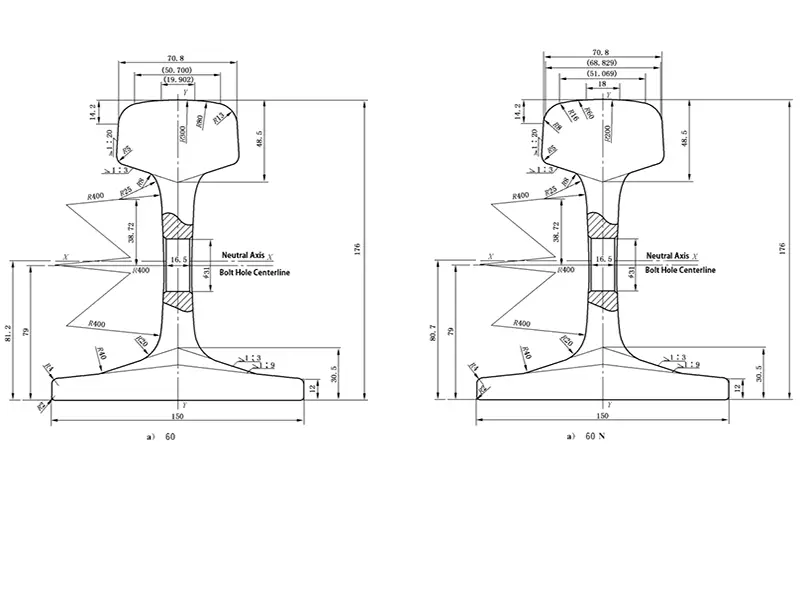
This selective hardening creates several benefits:
- Higher surface hardness: typically 20–40% higher than standard rails.
- Longer wear life: especially under slow-speed, high-load rolling and sliding contact.
- Better resistance to plastic deformation: such as squatting, corrugation, or crushing of the rail head.
- Balanced mechanical behavior: a hard surface to resist wear, supported by a tough body that absorbs impact and prevents brittle fractures.
In simple terms, the rail gains a hardened “armor layer” on top while keeping the rest of the structure flexible and strong.
Why Optimized Rail Profiles Alone Aren’t Enough
In railway systems, improved profiles such as China’s 60N rail have proven value. These designs optimize the wheel-rail contact geometry by keeping the running band centered and stable. The result is smoother operation, reduced lateral forces, less grinding, and better long-term alignment.
However, in industrial settings, the working conditions differ sharply from railways:
- Wheel loads are much higher, especially for RTG/RMG cranes, steel plant carriers, and heavy transport carts.
- Movement is slower and more repetitive, creating severe wear patterns and localized deformation.
- Sliding and scrubbing friction are common during steering or maneuvering.
- Environmental factors such as salt spray, moisture, abrasive dust, and corrosive chemicals accelerate wear and pitting.
- Downtime is extremely costly for ports and plants running around the clock.
Even the best-optimized profile cannot overcome these extreme conditions on its own. The issue is not geometric mismatch—it’s material fatigue, abrasive damage, and deformation under crushing loads. This is where head-hardened rails become essential.
Key Advantages of Head-Hardened Rails in Industrial Applications
1. Superior Wear Resistance
The hardened surface dramatically reduces wear from rolling, sliding, and abrasion. In many port and mining applications, head-hardened rails last 2–3 times longer than standard rails. This translates into extended replacement intervals and far fewer shutdowns.
2. Better Resistance to Plastic Deformation
Under extremely high loads, standard rails may develop dents, corrugation, or surface fatigue cracks. The hardened layer of head-hardened rails helps maintain track geometry, ensuring smoother crane movement and more predictable operation.
3. Lower Lifecycle Cost
While head-hardened rails cost more upfront, their total cost of ownership is significantly lower. The savings come from:
- fewer rail replacements
- reduced grinding
- less downtime
- improved equipment longevity
For facilities operating 24/7, minimizing interruption is often more valuable than the rail itself.
4. Strong Performance in Abrasive and Harsh Environments
Mining sites, bulk terminals, and material-handling plants often have abrasive dust, moisture, and contamination that accelerate wear. The hardened rail head resists micro-cutting, pitting, and spalling far better than standard rails.
Where Head-Hardened Rails Are Most Needed
Head-hardened rails have become the preferred choice in environments where loads are severe and maintenance windows are limited:
- Port container yards (RTG/RMG crane runways)
- Steel mills and heavy industrial plants
- Mining operations and bulk handling systems
- Heavy-duty factory tracks and in-plant logistics
- Industrial railway spurs with repetitive loading
In these settings, the increase in reliability and service life is substantial enough to justify the upgrade.
How to Choose and Plan for Head-Hardened Rails
- Evaluate load conditions: wheel loads, axle load, frequency, and operating cycles.
- Assess environmental factors: corrosion, dust levels, contamination, moisture, or chemicals.
- Check compliance and certification for hardness depth, hardness gradient, and metallographic results.
- Perform a lifecycle cost analysis comparing initial investment vs. long-term savings.
- Plan proper installation and alignment, ensuring the rail can fully utilize its enhanced durability.
Conclusion
Head-hardened rails are now essential in ports, mines, and heavy industrial yards—where standard rails crack or flatten within months. The cause? Slow-moving, high-axle-load equipment grinding over the same track section, day after day, under abrasive dust, moisture, and repeated impact. Hardening the rail head is the only proven way to resist this localized wear.